Lesson: Being a Critic of the Arts
🎨 Gallery: Being a Critic of the Arts
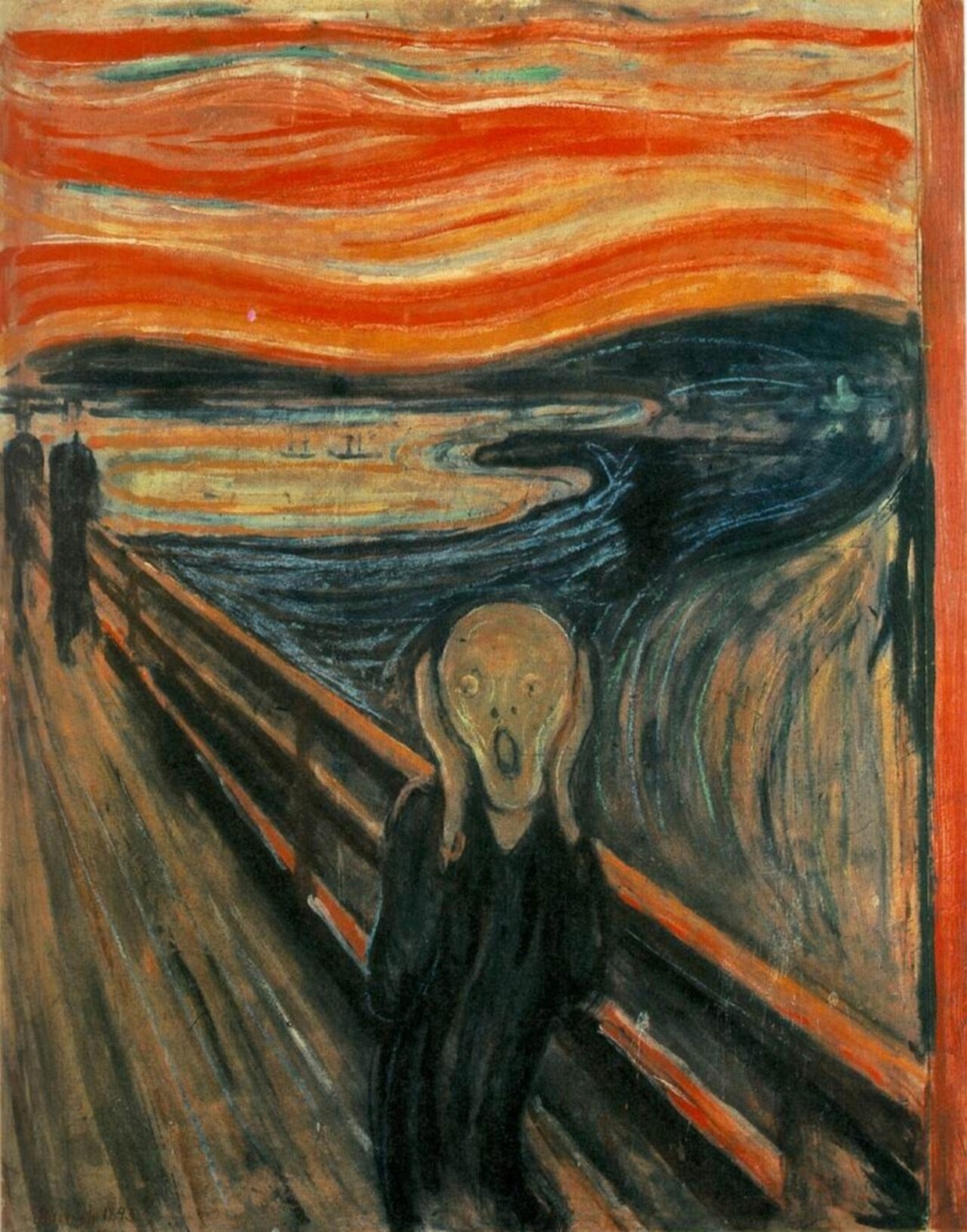
This lesson walks through the key ideas of the unit and then applies them to three works of art. Start with the Gallery above, then read on.
The word "criticism" often carries a negative connotation, as if to criticize something means to find fault with it. This lesson uses the word differently. Criticism, in the humanities, is the disciplined practice of paying attention to a work of art and saying something informed about it. It can be positive, negative, or neither. What makes it criticism is that it is careful, structured, and grounded in observation.
You are already a critic. Every time you choose one film over another, skip a song, or stop to look at a painting, you are making a critical judgment. The difference between casual judgment and responsible criticism is method. Responsible criticism aims for the fullest understanding and the fullest participation possible. It requires patience, careful observation, and a willingness to look longer than feels comfortable.
This lesson presents three kinds of criticism, each with a different focus. They build on each other, and the order matters.
Descriptive criticism focuses on form. It asks: what do you see (or hear, or read)? The goal is to give a careful, detailed account of the formal elements in a work of art without yet interpreting what they mean. This sounds simple, but it is the most important step, because everything else depends on it. If you describe poorly, you will interpret poorly, and you will evaluate on shaky ground.
This lesson breaks descriptive criticism into three levels:
Three Levels of Description
Detail relationships: How do individual small elements (a brushstroke, a color, a gesture, a single note) relate to each other?
Regional relationships: How do larger areas or sections of the work relate to each other?
Structural relationships: How do the parts relate to the whole? What organizes the entire composition?
This lesson uses Leonardo da Vinci's The Last Supper to demonstrate structural relationships. The painting is organized around a single vanishing point directly behind Christ's head, and the twelve apostles are arranged in four groups of three on either side. That structure is not a detail or a region; it is the principle that governs how everything in the painting fits together. The Critic's Practice exercise for this unit asks you to practice this kind of description.
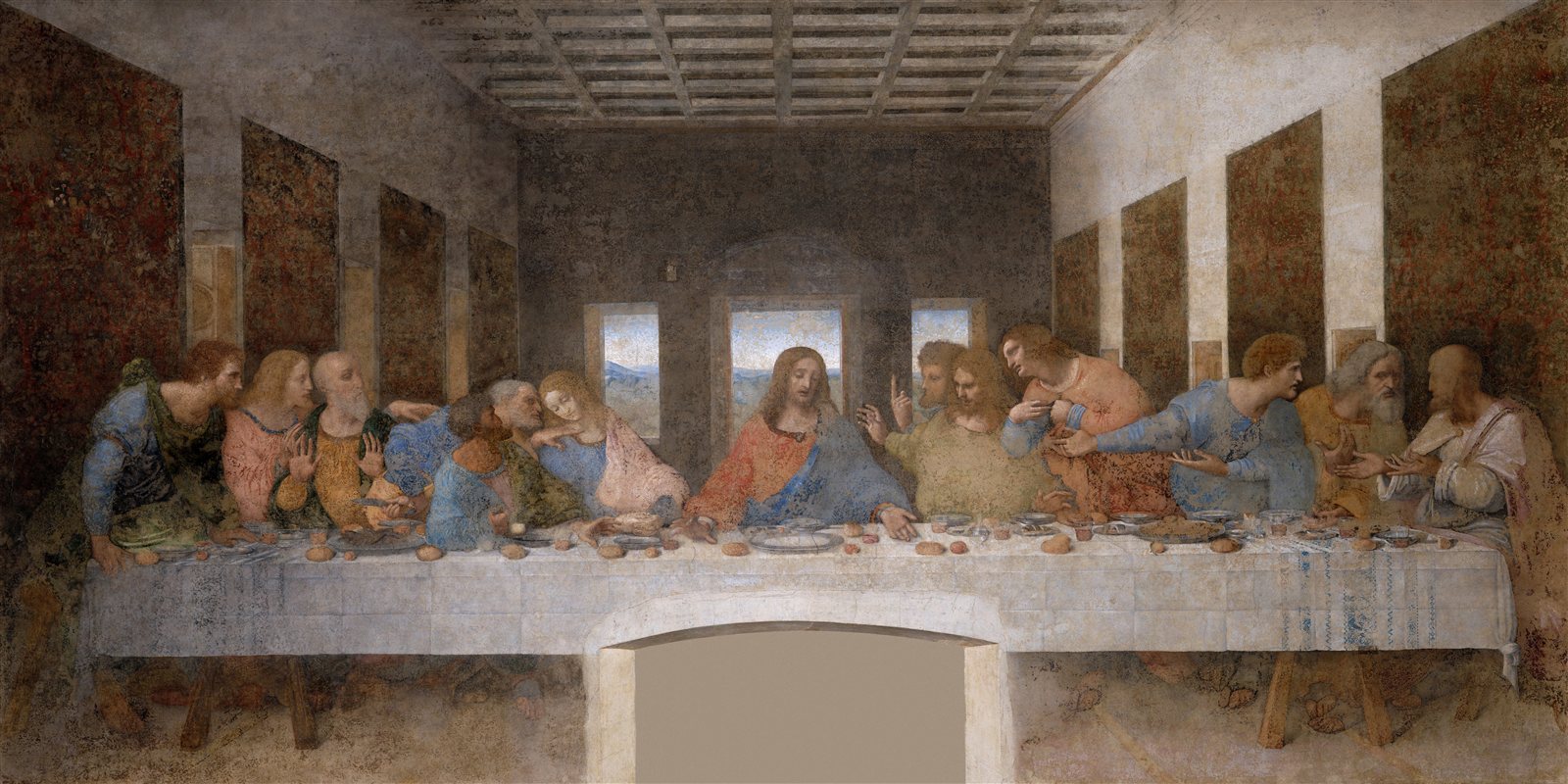
Leonardo da Vinci, The Last Supper, 1495–1498. Tempera and oil on plaster, 460 × 880 cm. Santa Maria delle Grazie, Milan.
Good descriptive criticism enhances your powers of observation. It slows you down and forces you to notice things you would otherwise miss. That noticing is what makes the next step possible.
Interpretive criticism focuses on content. It asks: what does this work mean? How does the form transform the subject matter into something meaningful?
This step depends entirely on the descriptive work you did first. You cannot say what a painting means if you have not first looked carefully at how it is composed. Interpretive criticism takes the observations from descriptive criticism and asks what they add up to. It is the step where you move from "I see four groups of three apostles arranged symmetrically around Christ" to "the composition creates a sense of order being disrupted by the announcement of betrayal."
Two important points from this lesson. First, interpretive criticism is more subjective than descriptive criticism. Two critics looking at the same painting may describe the same formal elements but interpret them differently. That is acceptable, as long as each interpretation is grounded in specific observations. Second, interpretive criticism requires familiarity with the subject matter. You need to know what the Last Supper was before you can interpret Leonardo's treatment of it. Background knowledge is not a substitute for looking, but it gives your looking something to work with.
This lesson's formula is direct: interpretive criticism explains how form transforms subject matter into content. That formula is worth memorizing.
Evaluative criticism focuses on merit. It asks: how good is this work? This is the most demanding type of criticism and also the most controversial, because it involves judgment. This lesson is careful to say that evaluative criticism is not prescriptive: it does not tell you what to like. It does, however, propose three standards for judging quality.
Three Standards for Evaluation
Perfection: Does everything in the work contribute to the whole? Is the artistic form fully unified?
Insight: Does the work reveal something meaningful about human experience? Does it make a difference in our lives, or does it merely please us for a moment?
Inexhaustibility: Does the work reward repeated engagement? Can you return to it and find something new each time? The stronger the content, the richer the insight, and the more the work resists becoming stale.
Evaluative criticism presupposes both descriptive and interpretive criticism. You cannot judge a work's merits if you have not first described its form and interpreted its content. This is why the three types build on each other and why the order matters: describe first, interpret second, evaluate third.
Supplemental Works
Each of the three works below is paired with one type of criticism. The analyses model what that type of criticism looks like in practice.
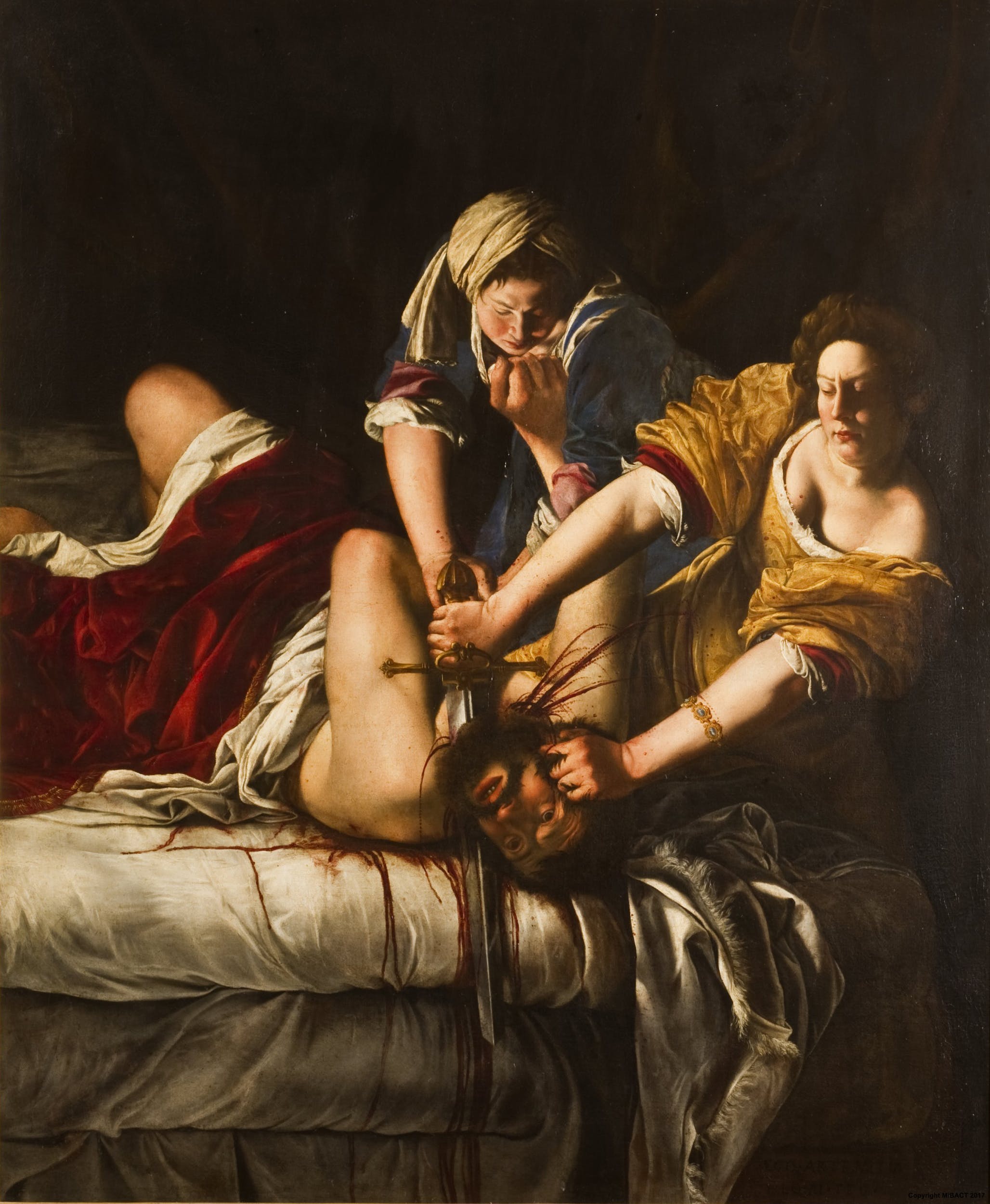
Artemisia Gentileschi, Judith Slaying Holofernes, c. 1620. Oil on canvas, 199 × 162.5 cm. Uffizi Gallery, Florence. Public domain.
Demonstrates: Descriptive Criticism
Start with details. Three figures fill the canvas. On the left, Judith grips a sword in her right hand and drives it into the neck of Holofernes, an Assyrian general. Her left hand holds his hair. Her sleeves are rolled up. On the right, her maidservant Abra pins Holofernes down, pressing against his chest with both hands. His arms push outward in a futile attempt to free himself. Blood runs in dark lines across the white bedsheets.
Now regional relationships. The painting divides roughly into two zones: the lit foreground where the action takes place, and the dark background that drops away into near-total blackness. The light enters from the upper left and falls across the women's arms, faces, and the white linen, creating a stark contrast between flesh, fabric, and shadow. The dark background pushes everything forward, trapping the viewer in the scene.
Structural relationships. The composition is organized around a tight triangle formed by the three heads. Judith and Abra lean inward from opposite sides while Holofernes struggles between them. The sword is nearly vertical, creating a strong central axis. The diagonal of his body (pushing left) opposes the diagonal of Judith's arms (pressing right), locking the entire composition in a moment of physical tension. Nothing in the painting is incidental. Every element contributes to the sensation of forceful, deliberate action.
Notice that this analysis has not yet said what the painting means. It has only described what is there and how the parts relate. That is descriptive criticism: a careful inventory of form that prepares you for interpretation.
Try this
Look at the expressions on the three faces. Describe each one without interpreting it (do not say what the person is "feeling," just describe what the face looks like: the position of the mouth, the direction of the eyes, the angle of the head). This is harder than it sounds, and it is exactly the discipline that descriptive criticism requires.
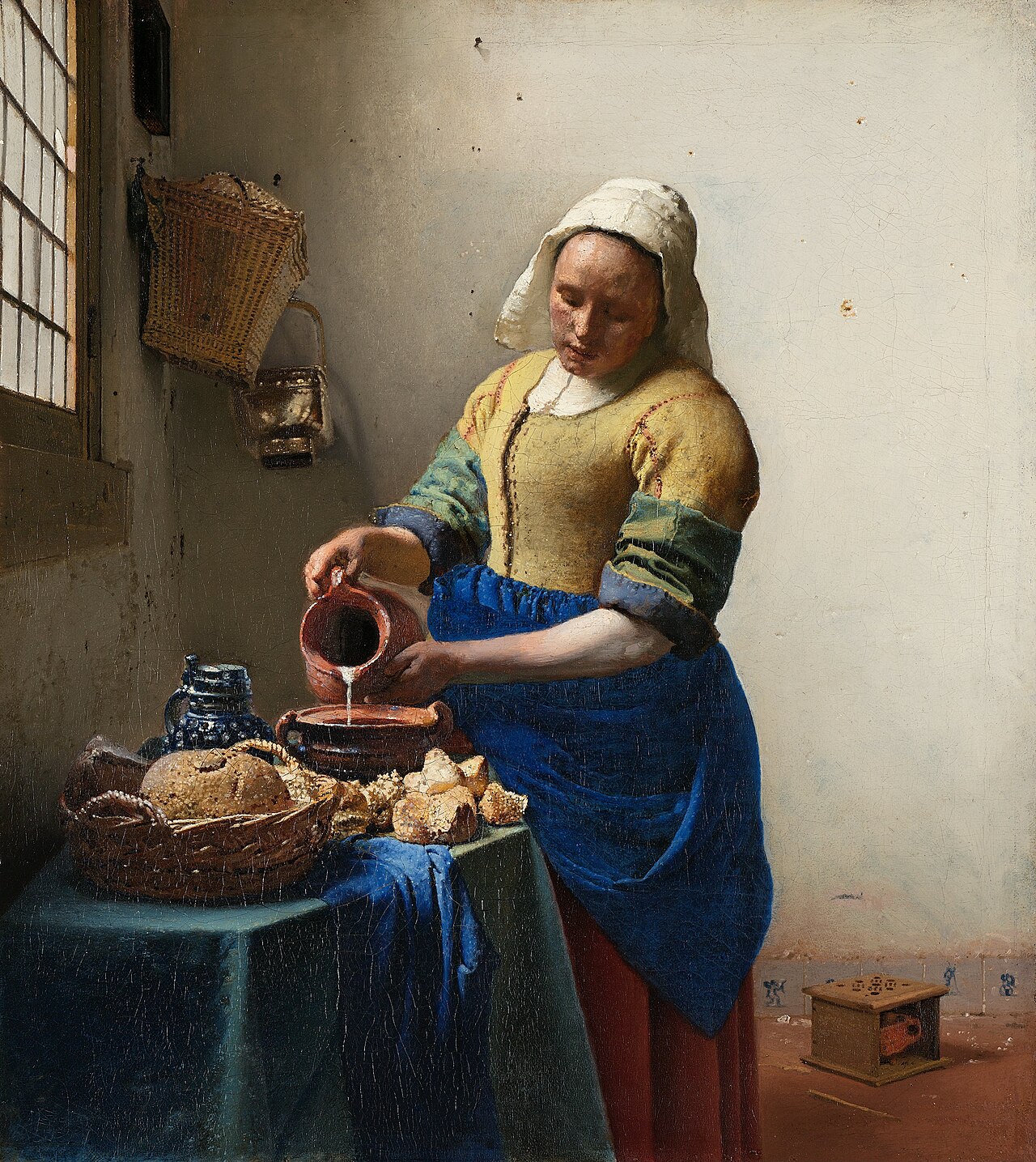
Johannes Vermeer, The Milkmaid, c. 1658. Oil on canvas, 45.5 × 41 cm. Rijksmuseum, Amsterdam. Public domain / Rijksmuseum Open Access.
Demonstrates: Interpretive Criticism
The subject matter of this painting is ordinary: a woman pours milk. That is all. There is no drama, no mythology, no historical event. A servant in a plain room does a household task. And yet this is one of the most celebrated paintings in the history of Western art. Why?
Interpretive criticism answers that question by showing how form transforms this simple subject into something richer. Start with the light. It enters from the window on the left and falls across the woman's face, arms, and the stream of milk with extraordinary precision. Vermeer renders the light so carefully that you can see individual dots of brightness on the bread crusts and the rim of the jug. This is not just realism; it is a formal choice that gives weight and solidity to ordinary objects.
Now look at the woman herself. She stands in a pose of complete absorption. Her downward gaze follows the stream of milk. Her arms are strong and steady. She is not performing for the viewer; she is doing her work. The composition reinforces this impression: the figure is placed slightly off-center, grounded by the heavy table in the foreground and the plain wall behind. There is nowhere for your eye to go except to her and the act she is performing.
The content, then, is not just "a woman pouring milk." The artistic form transforms that subject matter into a statement about the dignity of labor, the beauty available in ordinary moments, and the power of sustained attention. Vermeer treats a servant's work with the same compositional care that other painters reserved for kings and saints. That decision is itself an interpretation of the subject matter, and recognizing it is what interpretive criticism does.
Try this
Imagine that Vermeer had painted this woman looking directly at the viewer and smiling. How would that change the content? The subject matter (a woman pouring milk) would stay the same, but would the meaning be different? This kind of thought experiment helps clarify how form creates content.
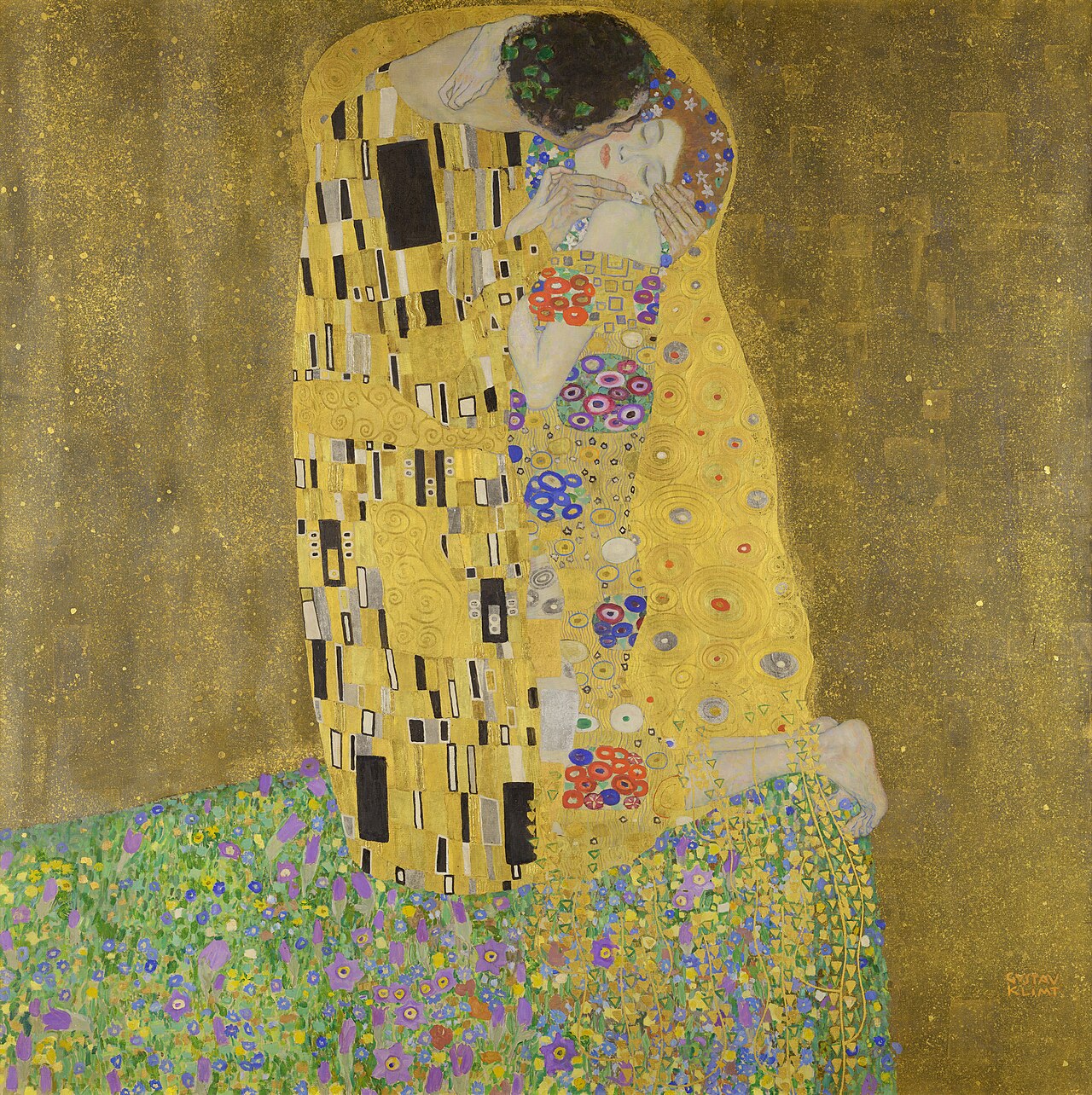
Gustav Klimt, The Kiss, 1907–1908. Oil and gold leaf on canvas, 180 × 180 cm. Österreichische Galerie Belvedere, Vienna. Public domain.
Demonstrates: Evaluative Criticism
Evaluative criticism asks whether a work meets the three standards of perfection, insight, and inexhaustibility. Klimt's The Kiss is a useful test case because it is both enormously popular and genuinely complex.
Perfection. Does everything in the painting work together? The two figures are wrapped in gold-patterned robes that merge them into a single form, kneeling at the edge of a flower-covered cliff. The man's robe has rectangular, angular patterns; the woman's has circular, organic ones. Those patterns distinguish the two figures while the gold unifies them. The background is a flat gold field that eliminates depth and makes the couple appear suspended outside of time. Every element (the gold, the patterns, the flowers, the cliff edge, the flat background) contributes to a single effect: two people enclosed in a private world. The formal unity is strong.
Insight. Does the painting reveal something meaningful about human experience? The subject matter is love, or more precisely, a moment of physical closeness. But the content goes further. The way the gold absorbs both figures suggests that intimacy involves a loss of individual boundary. The woman's face, turned sideways with closed eyes, expresses surrender. The flowers at the cliff edge suggest fragility. The painting is not simply saying "love is beautiful." It is saying something about the way intimacy dissolves the self, and it is using form (the merging patterns, the gold envelope, the precarious cliff) to make that idea visible.
Inexhaustibility. Can you return to this painting and find something new? This is harder to demonstrate on a page, but consider: the painting has been reproduced on posters, calendars, and coffee mugs for over a century (much like Hokusai's Great Wave from Unit 1). Yet scholars and viewers continue to notice new things in it: the tension between the geometric and organic patterns, the ambiguity of the woman's expression (is it bliss or resignation?), and the way the cliff edge introduces danger into an image of safety. That capacity to reward repeated attention is what this lesson means by inexhaustibility.
Try this
Think of a work of art you have returned to many times (a song, a film, a painting). Does it meet the standard of inexhaustibility? What is it about the work that makes it resist becoming stale? Try to connect your answer to the work's artistic form rather than just its subject matter.
With Units 1 through 3, you now have the foundation for the rest of the course. You know what the humanities study (values), what a work of art is (artistic form, participation, subject matter, content), and how to analyze one (descriptive, interpretive, and evaluative criticism). Everything that follows applies these tools to specific art forms.
Unit 4 begins with painting, the first of the genre-specific units. You will learn the vocabulary particular to painting (line, color, composition, texture) and see how the critical frameworks from Unit 3 work when applied to a single medium. The pace of new vocabulary will increase, but the underlying logic stays the same: describe what you see, interpret what it means, and evaluate how well it works.
Experience It: Describe, Interpret, Evaluate
Open Vermeer's The Milkmaid in the Gallery above. You will write three short responses, one for each kind of criticism, and you must finish each one before starting the next.
- Describe. List at least five things that are actually there: colors, objects, light, the woman's posture. Use no opinions and no guesses about meaning.
- Interpret. What might this quiet moment suggest about work, care, or dignity? Point to one detail from your list that supports your reading.
- Evaluate. Does the painting reward being looked at again and again? Say what standard you are using, and give one reason it does or does not meet it.
Further Exploration
- Smarthistory: Leonardo da Vinci, The Last Supper, a video essay on its geometry and storytelling
- Smarthistory: Artemisia Gentileschi, Judith Slaying Holofernes, an essay on how the painting reworks a familiar story
- Wikipedia: Art criticism, an overview of how critics describe, interpret, and judge art