Critic's Practice: The Last Supper
Practice descriptive criticism on one of the most studied paintings in Western art. This exercise is for your own learning: nothing is submitted and nothing is graded.
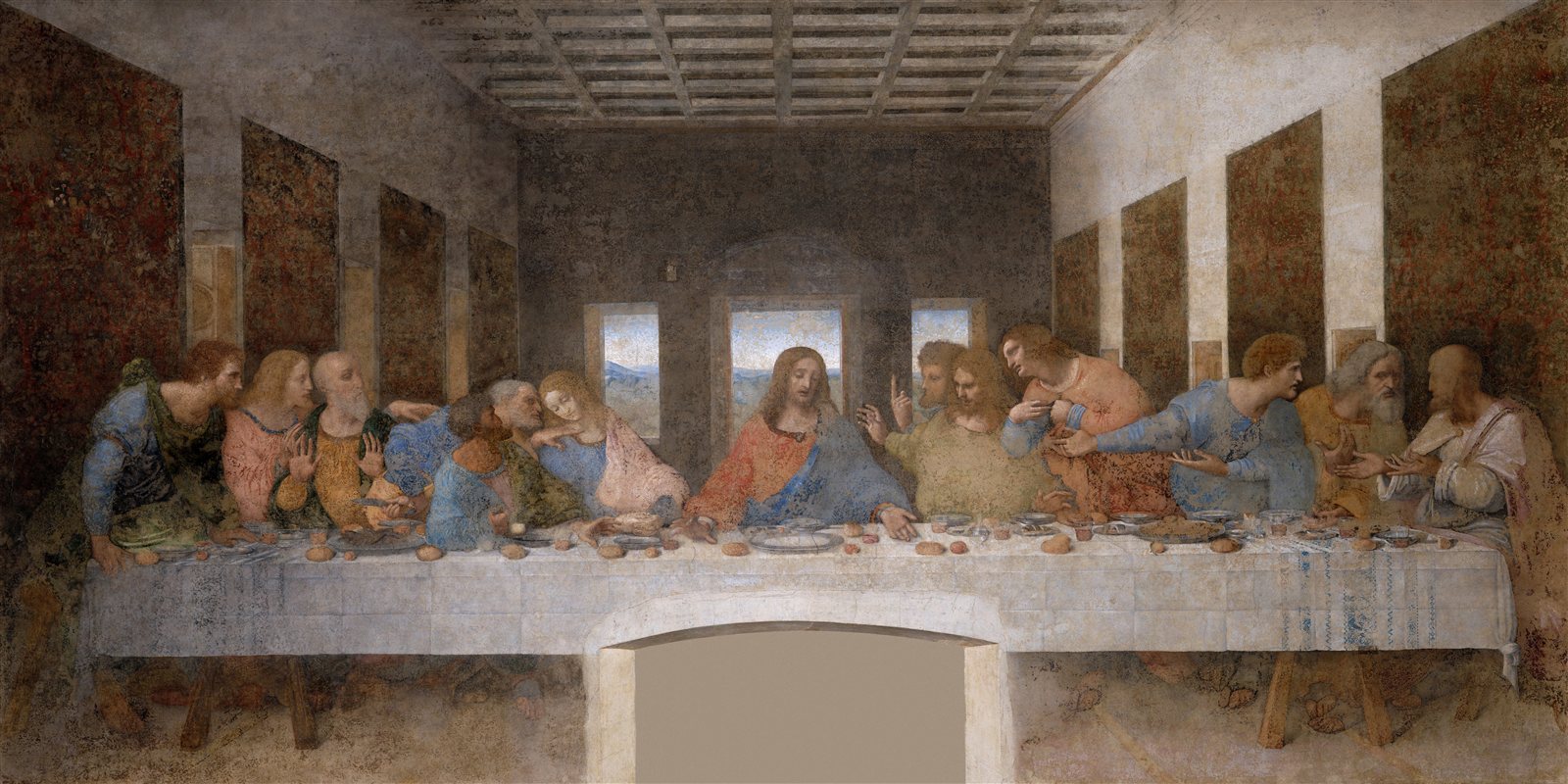
Leonardo da Vinci, The Last Supper, 1495–1498. Tempera and oil on plaster, 460 × 880 cm. Santa Maria delle Grazie, Milan. Public domain.
Leonardo painted The Last Supper on the wall of the dining hall of the convent of Santa Maria delle Grazie in Milan. It shows the moment from the Gospel of John when Christ announces to his twelve apostles that one of them will betray him. The painting measures roughly 15 by 29 feet. Christ sits at the center of a long table, his arms open, his expression calm. The apostles are arranged in four groups of three on either side, each group reacting to the announcement with different gestures and expressions. The lines of the ceiling, walls, and floor converge on a single point behind Christ's head, and three windows behind him open onto a distant landscape.
Study the image carefully before you begin writing.
Your exercise
Write a descriptive criticism of the painting, about 250 to 500 words, that describes its form at all three levels:
- Detail relationships: individual gestures, expressions, and objects, and how they relate to each other
- Regional relationships: how larger areas, such as the groups of apostles, the table, and the windows, relate to each other
- Structural relationships: how the parts relate to the whole composition, and what organizes it
Focus on what you can observe: the arrangement of the figures, the use of perspective, the role of light, and the gestures and expressions of the apostles. You do not need to name each apostle, but you should say what each group is doing and how it relates to the figures around it.
Describe only. This is a descriptive exercise, not an interpretive or evaluative one. You are not asked what the painting means or whether it is successful. You are asked to describe its form as precisely and thoroughly as you can. The better you describe, the more you will see.
Your Notes
This is a thinking space — your response is not saved or submitted. Copy your work if you want to keep it.