De Beauvoir's Life and Context
A philosopher who refused to separate thinking from living
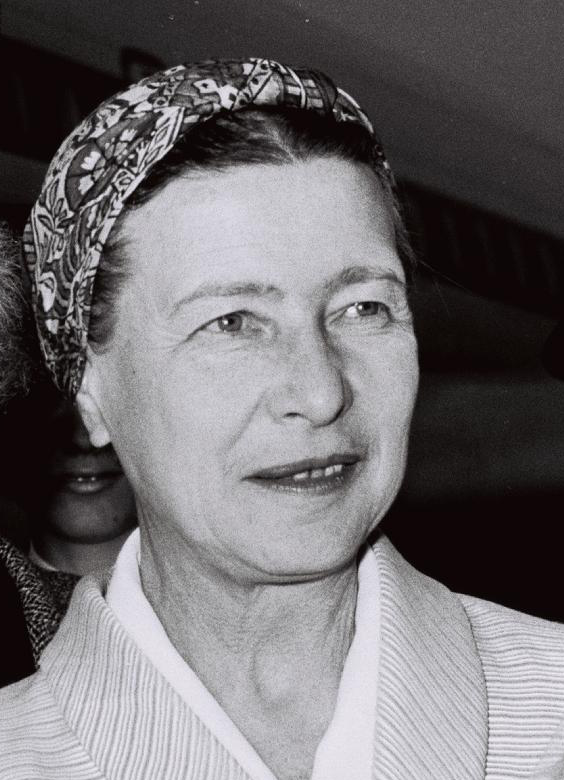
De Beauvoir is the first woman philosopher in this course, and one of the most important moral philosophers of the twentieth century. Her work is inseparable from the historical moment she was living through.
Simone de Beauvoir (1908–1986) was born in Paris to a bourgeois Catholic family whose fortunes declined significantly after World War One. The family's financial difficulties pushed her father, a frustrated lawyer with literary ambitions, to regard a serious education for his daughters as their best practical option. De Beauvoir took that option with single-minded intensity. She studied mathematics and philosophy, eventually passing the agrégation in philosophy in 1929, the most demanding competitive examination in the French academic system, at twenty-one. She placed second in the country; Jean-Paul Sartre placed first. They had been rivals in the examination; they would be companions for the rest of their lives.
Her relationship with Sartre is one of the most examined intellectual partnerships in modern history, and it has been both celebrated and contested in roughly equal measure. They never married, refused monogamy, and regarded their relationship as the primary commitment around which other relationships were organized. They shared philosophical ideas at every stage of development, coauthored in the sense that each work shaped the other's thinking, and maintained a joint intellectual project even as their political and personal paths sometimes diverged. What gets obscured in the celebrity version of their relationship is how thoroughly philosophical the partnership was: they disagreed substantively, challenged each other's arguments, and produced work that neither would have produced alone.
Her career as a writer covered novels, autobiography, travel writing, political essays, and philosophical works. She Came to Stay (1943), her first novel, explored the existentialist themes of consciousness and the other. The Second Sex (1949) became the founding text of modern feminist theory, arguing that women's subordination was not natural but historically and socially constructed. The Ethics of Ambiguity (1947) is her major work in moral philosophy. The Mandarins (1954) won the Prix Goncourt, France's most prestigious literary prize.
Her later career was marked by sustained political engagement: against French colonialism in Algeria, against the Vietnam War, in support of abortion rights and feminist organizing. She was one of the most visible public intellectuals in post-war France and remained so until her death in 1986, three years after Sartre.
No account of de Beauvoir's life can be complete without acknowledging serious allegations from her years as a lycée teacher in the 1930s. Multiple former students, most notably Bianca Lamblin, alleged that de Beauvoir initiated sexual relationships with students who were minors and then introduced them to Sartre. In 1943 de Beauvoir was suspended from teaching and permanently lost her teaching license following a formal complaint. These are not minor biographical footnotes; they represent a genuine contradiction between the ethics de Beauvoir theorized and the conduct she practiced. Engaging honestly with that contradiction is part of what it means to read her seriously. Her philosophical work does not depend on her being a morally admirable person, but her particular arguments about authentic freedom and responsibility give these facts a sharper edge than they might carry for another thinker.
The Ethics of Ambiguity was published in 1947, two years after the end of World War Two, in the immediate aftermath of the Holocaust, Hiroshima, and the collapse of a generation's confidence in historical progress. It was written in an intellectual environment that had been permanently altered by the realization that educated, cultivated people in modern nation-states were capable of industrialized mass murder. The old moral frameworks, religious and secular alike, had not prevented this. The question of how to live and act responsibly in a world without guaranteed moral foundations was not academic.
Existentialism was the philosophical movement that tried to take that question seriously. Associated primarily with Sartre in France, it began from the claim that human beings have no predetermined essence: we are not born with a fixed nature that determines what we ought to be and do. There is no God-given purpose, no teleological order, no rational moral law waiting to be discovered. Instead, existence precedes essence: we first exist, and then we create what we are through our choices. This sounds liberating, and in some ways it is. But it is also terrifying, because it means there is no external authority to appeal to. We are responsible for what we make of ourselves, and that responsibility is total.
Sartre's existentialism was powerful and influential, but it had a problem: it was not obvious how it could generate genuine moral obligations. If there are no fixed values, if freedom is absolute, why should I care about anyone else's freedom? Sartre himself acknowledged that deriving an ethics from existentialist premises was a project he had not completed. De Beauvoir completed it. The Ethics of Ambiguity is her argument that the structure of freedom itself, when honestly confronted, generates genuine moral obligations, including obligations to others.
The title tells you the central move. "Ambiguity" refers to the fundamental condition of human existence: we are beings who are both free and situated, both transcending our circumstances and embedded in them. We are not pure consciousness floating above the world. We are embodied, historically located, shaped by class, race, sex, language, and the choices of previous generations. We cannot shed these conditions any more than we can shed our bodies. And yet we are also irreducibly free: no set of circumstances simply determines what we do with them. The human being is this contradiction, this ambiguity, and the question is how to live it honestly rather than flee it.
Most people, de Beauvoir argues, spend most of their time fleeing it. The flight takes various forms, which she catalogs in Part Two: some people immerse themselves in a "cause" and let the Cause think for them; some drift in passive bad faith; some perform a kind of cool nihilism that is really just disappointed seriousness; some pursue excitement for its own sake without genuine engagement. All of these are ways of escaping the weight of freedom, and all of them ultimately fail on their own terms.
The book's positive argument is that genuine freedom, honestly embraced rather than fled, is not compatible with indifference to others. Because my freedom is situated and can only realize itself through projects in a shared world, the conditions of others' freedom are the conditions of my own. This is not an argument from sympathy or altruism; de Beauvoir is not asking you to feel fond of other people. It is an argument from the structure of freedom itself: what I am genuinely willing when I will my own freedom includes willing the freedom of those on whose freedom my own projects depend.
Whether that argument is sound is what the unit’s reflection prompt will ask you to work out. What is beyond dispute is that de Beauvoir is attempting something that no previous thinker in this course attempted: to construct a positive ethics from the ruins of the foundations that Nietzsche's genealogy exposed, using only the structure of freedom as a starting point.
This video covers de Beauvoir's biography and place in the history of philosophy. Watch it before starting on Part One.
Part One: Ambiguity and Freedom. De Beauvoir sets up the philosophical problem. She argues that human beings are marked by a fundamental ambiguity: we are simultaneously free consciousnesses that transcend our situation and beings who are embedded in and shaped by a world we did not choose. Most ethical systems, she argues, have tried to resolve this ambiguity by emphasizing one side at the expense of the other, either reducing human beings to determined creatures of nature or treating them as pure rational wills untouched by circumstance. She insists on holding both together. The ethical task is not to escape ambiguity but to assume it honestly.
Part Two: Personal Freedom and Others. The longer and more analytically rich section. De Beauvoir catalogs several attitudes of bad faith, that is, several characteristic ways people flee from genuine freedom into false security. The sub-man, the serious man, the nihilist, the adventurer, the passionate man: each represents a recognizable human type, and each represents a failure to live with the full weight of freedom. Against all of them she develops her account of what genuine freedom looks like, arriving at the book's central claim: that to genuinely will one's own freedom is also to will the freedom of others. This is not a sentimental claim; she develops it as a structural argument. Work through it carefully, because it is the pivot on which the whole book turns.