Unit 2: Overview
Thomas Aquinas: Natural Law and the Order of Reason
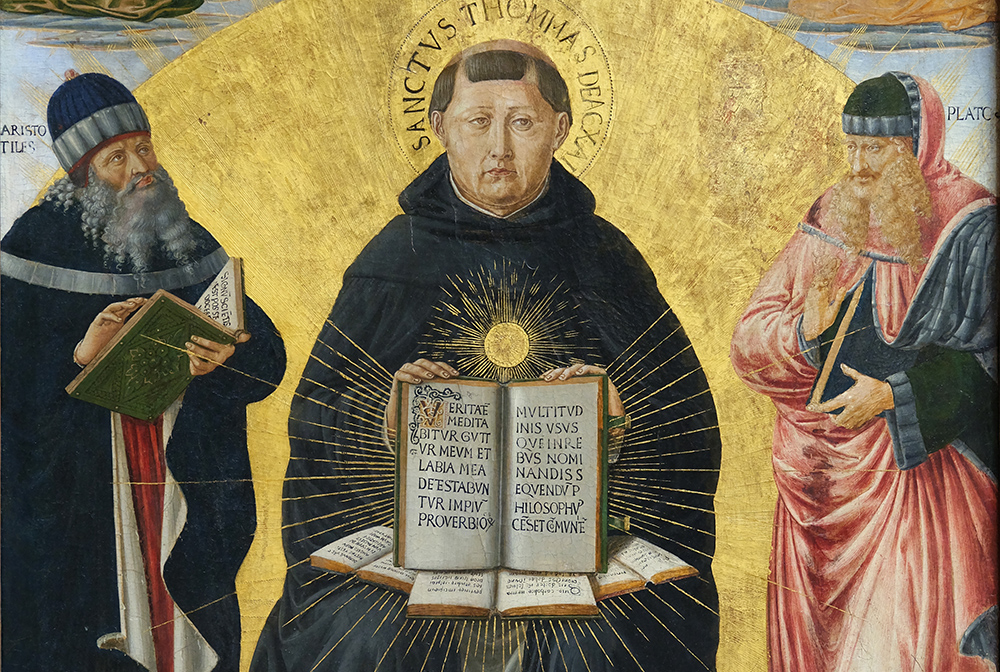
Sixteen centuries after Aristotle, a Dominican friar takes up the same questions and gives them new answers by putting them inside a Christian cosmos. The result is the most influential ethics in Western Christendom.
Aristotle left us with an ethics grounded in human nature. The good life, he said, is the life in which we fulfill our distinctive function as rational creatures. Virtues are the habits that let us do this well. It is a powerful picture, but it leaves an obvious question unanswered: where does human nature itself come from, and what grounds it?
For Aristotle, this question did not need a full answer. Nature was simply there, built into the cosmos. Sixteen centuries later, Thomas Aquinas takes up Aristotle's framework and puts it inside a Christian universe. Human nature is now the nature God created humans to have. The telos we aim at is the end God designed us for. And the moral order that Aristotle thought was woven into the fabric of things turns out, on Aquinas's view, to be an expression of the divine mind.
This is not a small adjustment. Aquinas's Christianization of Aristotle produces the most systematic ethical theory of the medieval period and one of the most influential in the history of Western thought. It gives rise to the tradition of natural law: the idea that there are moral principles built into the structure of creation, accessible to any rational creature, binding regardless of what any government or custom happens to say. Natural law theory is still active today in Catholic moral theology, in international human rights discourse, and in ongoing debates about whether some laws are so unjust that they do not deserve the name of law.
What you will read in this unit is a short selection from Aquinas's enormous Summa Theologiae, focused specifically on his account of law. You will meet his distinction between four kinds of law (eternal, natural, human, divine), his account of the first precepts of natural law, and his famous claim that an unjust human law is no law at all.
← LOOKING BACK | LOOKING AHEAD →
Aristotle grounded morality in human nature. Aquinas keeps that structure but roots nature itself in God's reason. In Unit 3, Kant will reject the whole appeal to nature and try to ground morality in pure reason alone, without any appeal to what humans happen to be like.
The Summa Theologiae is organized in a distinctive way that will take some getting used to. Each topic is treated in a Question, and each Question is broken into Articles. Each Article follows the same rigid structure: a yes-or-no question is posed, objections to the answer Aquinas thinks is correct are listed, a counterargument is quoted (usually from Scripture or Aristotle), Aquinas gives his own position and argument, and then he replies to each of the objections in turn.
This is the Scholastic method, and it is built around disputation. Aquinas is not writing monologues. He is imagining a live argument and walking through all the moves. Expect the text to feel structured and repetitive. Once you see the pattern, it becomes easier to navigate: you learn to skim the objections, find the "I answer that" paragraph which contains the main argument, and then go back to read the objection-replies for the hard cases.
READING TIP
On a first pass, read the question title, the "I answer that" paragraph (which is the heart of the article), and the replies to objections. Skip the objections themselves until you understand Aquinas's position. The objections make much more sense once you know what he is arguing against.
By the end of this unit, you should be able to:
- Explain how Aquinas adapts Aristotle's ethics to a Christian framework.
- Define the four kinds of law and describe the relationship between them.
- State the first precept of natural law and explain how further precepts are derived from it.
- Evaluate Aquinas's claim that natural law is the same for everyone and universally knowable.
- Explain the claim that an unjust law is not really a law at all, and apply it to a concrete example.
- Identify the is/ought distinction and recognize when an argument moves from facts about human nature to claims about what we ought to do.
All readings for this unit come from Aquinas's Summa Theologiae, First Part of the Second Part (Prima Secundae), in the Dominican Fathers translation. The text is in the public domain and free to read online. Each link below opens one Question.
- Question 90: Of the Essence of Law (4 articles) — What a law is
- Question 91: Of the Various Kinds of Law (6 articles) — Eternal, natural, human, and divine law
- Question 94: Of the Natural Law (6 articles) — The first precept, what natural law contains, and whether it can change
- Question 95, Articles 1–2: Of Human Law — Whether human law is useful, and whether an unjust human law is really a law
ATTRIBUTION
Thomas Aquinas, Summa Theologica, translated by the Fathers of the English Dominican Province (1911). Public domain. Source text from New Advent.
What you need to complete this unit
Work through each item in order.
- Read the lesson pages in this unit and watch the lecture videos on them
- Read the assigned text (see Readings above)
- Complete the reflection prompt
- Take the unit quiz
ACCESSIBILITY
If any material in this unit is not accessible to you, please contact me by email right away. I will work with you to find a solution.
In This Unit
- Aquinas' Life and Context
- Reason and Faith
- Four Kinds of Law
- Natural Law and Its Precepts
- Reflection Prompt
- Quiz: Thomas Aquinas