Kant's Life and Context
A Prussian philosopher who rewrote the foundations of modern thought from a single small city
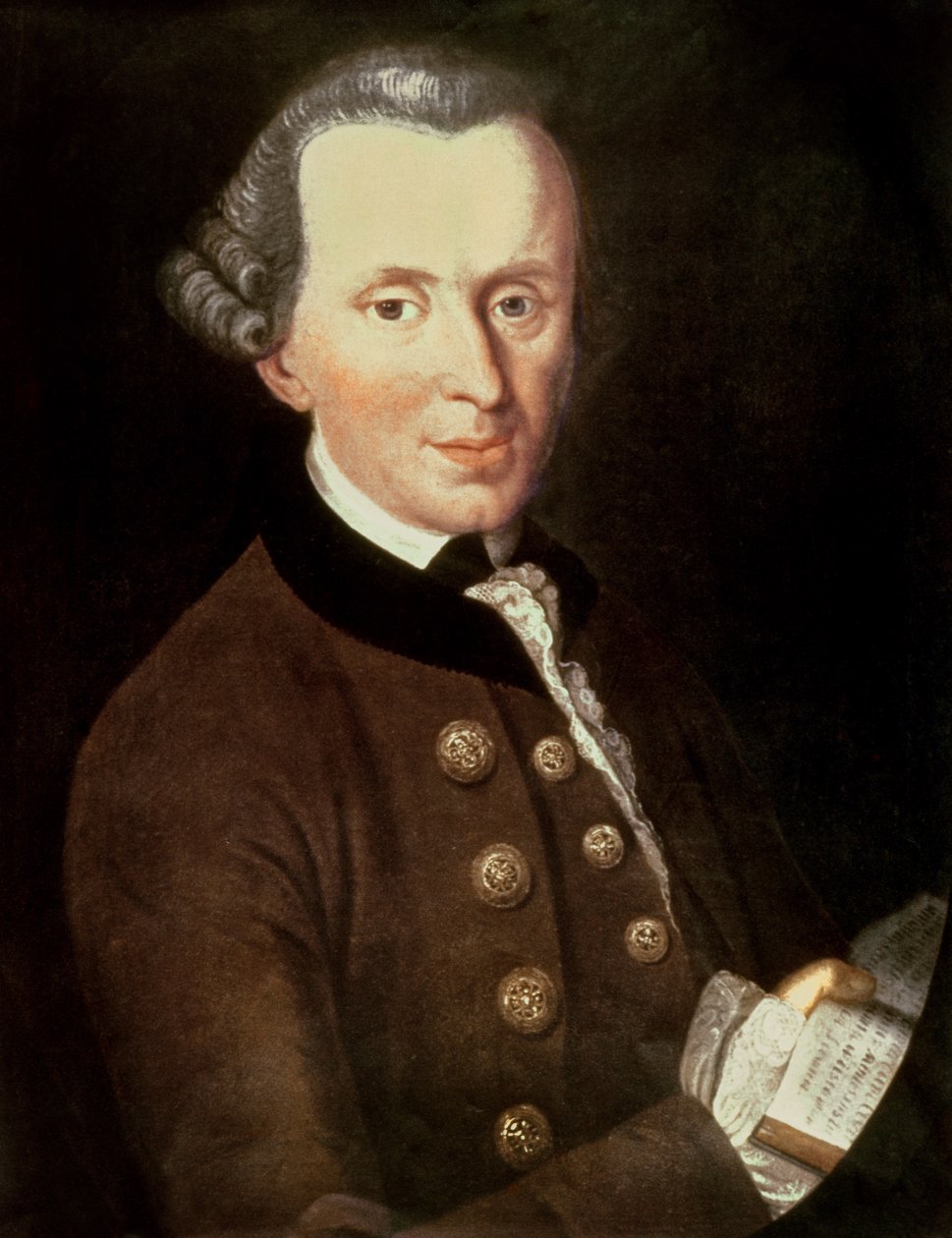
Kant's life was quiet to the point of parody. His ideas were anything but.
Immanuel Kant (1724–1804) lived his entire life in or near Königsberg, a Prussian port city that no longer exists under that name (it is today Kaliningrad, a Russian enclave on the Baltic). He was born there, attended university there, taught at the university there, and died there. He never traveled more than about sixty miles from home. This is unusual even by the standards of 18th-century academics, and it has become part of his legend.
The legend is not just that Kant stayed put. It is that his daily routine was so precise that townspeople supposedly set their watches by his afternoon walks. Like many legends, this one is partly exaggerated, but the underlying truth is real. Kant lived by habit. He rose at the same hour, lectured and wrote on a fixed schedule, took the same walk every afternoon, and never married. His biographers differ on whether this regularity was the condition of his extraordinary productivity or a symptom of a nervous temperament that needed order to function. Probably both.
His family was modest. His father was a harness maker, his mother a devout Pietist Lutheran. Kant's upbringing stressed moral discipline, inner reflection, and a suspicion of outward religious show. He went to a Pietist Latin school he later described as drudgery, then to the University of Königsberg, where he studied a broad curriculum including philosophy, mathematics, and physics. After several years as a private tutor, he returned to Königsberg and worked his way up through the university, becoming a full professor of logic and metaphysics in 1770.
Then, for eleven years, Kant published almost nothing. He was working out the ideas that would appear in 1781 in the Critique of Pure Reason, the book that established him as one of the most important philosophers in history. He was fifty-seven years old at publication. The Groundwork, which we will read, came four years later, in 1785. Over the next fifteen years, Kant produced most of the works that are now considered canonical in modern philosophy.
Kant's work is a response to two debates that dominated European philosophy in the generations before him.
The rationalism/empiricism debate. Rationalists like Descartes and Leibniz held that the mind has innate structures through which we can know important truths about reality by pure reasoning, independent of experience. Empiricists like Locke and Hume held that all our knowledge comes from the senses, and that reason alone cannot reach substantive truths about the world. By Kant's time this debate had reached a kind of crisis. Hume, in particular, had argued that if we take empiricism seriously, we cannot even justify basic concepts like causation or personal identity. Kant later said that Hume "awoke him from his dogmatic slumber." His first great work, the Critique of Pure Reason, was his response: an attempt to show that both sides were partly right, and that the mind actively contributes structure to experience while still depending on sensory input for content.
The moral philosophy inherited from Hume, and from utilitarianism's early stirrings. Hume had also argued, in ethics, that moral judgments are ultimately grounded in feelings: sympathy, approval, disapproval. Around the same time, thinkers like Bentham were starting to argue that morality is about maximizing happiness and minimizing pain. Both of these approaches ground morality in psychological facts about human beings: our sentiments, our pleasures and pains. Kant found this picture of morality deeply unsatisfying. If morality is just a matter of what we happen to feel or what produces the most pleasure, then it has no genuine authority. Someone who feels differently, or who derives pleasure from different things, would be subject to different rules. Kant wanted to show that this is not what morality is. Real moral principles, he thought, must be binding on all rational beings as such, regardless of their psychology.
The Groundwork is the opening move in Kant's alternative. His question is not "what do humans happen to value?" but "what is morality such that it could genuinely bind us?" The answer he works out is one of the most ambitious in the history of philosophy.
The full title of the book tells you the project: a grounding for the metaphysics of morals. Both halves matter.
"Metaphysics of morals" is Kant's term for a part of ethics that works out the supreme moral principle by pure reasoning, without appealing to empirical facts about human psychology, biology, or culture. A metaphysics of morals asks: what principle would any rational being have to recognize as binding, just in virtue of being rational?
"Grounding" does not mean what it sounds like to modern ears. Kant is not writing a bedrock on which the metaphysics of morals will be built. He is writing the work of laying that foundation. The Groundwork is a preparatory book. Its job is to identify the supreme principle of morality and show that it applies to us, so that a full metaphysics of morals can then be developed in later work. Kant did write that fuller work, published three years later as the Critique of Practical Reason.
The Groundwork itself has three sections, and Kant announces what each one is going to do in his Preface. Section 1 starts from ordinary moral common sense and tries to extract from it the supreme principle. Section 2 starts over, more rigorously, and derives the same principle from pure rational reflection on what an imperative (a moral command) could even be. Section 3 then tries to justify our being bound by the principle, by connecting it to human freedom.
The three sections get progressively harder. Most readers find Section 1 fairly clear, Section 2 abstract but rewarding, and Section 3 genuinely forbidding. You should expect this pattern. It does not mean you are failing to understand; it means Kant is moving into territory that even careful readers struggle with.
This short video provides additional context on Kant's life and place in the history of philosophy. Watch it before starting on Chapter 1.
Here is what to expect in each part of the text.
The Preface tells you what the Groundwork is and is not. Kant distinguishes pure philosophy from empirical philosophy, ethics from natural science, and explains why he is writing a preparatory book rather than a complete system. Read the Preface, but do not worry if some of its distinctions pass by you. It will make more sense after you have seen the rest of the book.
Chapter 1 (titled "Moving from common-sense knowledge to philosophical knowledge about morality" in Bennett) is Kant's first pass at his topic. He starts with ordinary examples of moral judgment (the idea that a "good will" is the only unconditionally good thing, the concept of duty) and works his way up to a first statement of the supreme moral principle. This chapter is the most accessible in the book. It contains several famous discussions, including the shopkeeper who is honest only because honesty is good for business.
Chapter 2 (titled "Moving from popular moral philosophy to a metaphysics of morals") is the heart of the book. Kant starts over more rigorously, introduces the distinction between hypothetical and categorical imperatives, and gives multiple formulations of the categorical imperative. This is where the famous formulations appear: act only on a maxim you could will to be a universal law; treat humanity always as an end, never merely as a means. Kant also applies the formulations to four specific cases, which give you a sense of how he thinks moral reasoning works in practice.
Chapter 3 (titled "Moving from the metaphysic of morals to the critique of pure practical reason") is the hard one. Kant tries to show why we are actually bound by the categorical imperative. He argues that free will and the moral law imply each other, introduces his famous distinction between how the world appears and how it is "in itself," and claims that our sense of ourselves as free rational agents commits us to the moral law. The argument is compressed and difficult. Do what you can with it on a first reading and return to the parts that seemed most opaque.