Nietzsche's Life and Context
A philosopher who burned every bridge he crossed
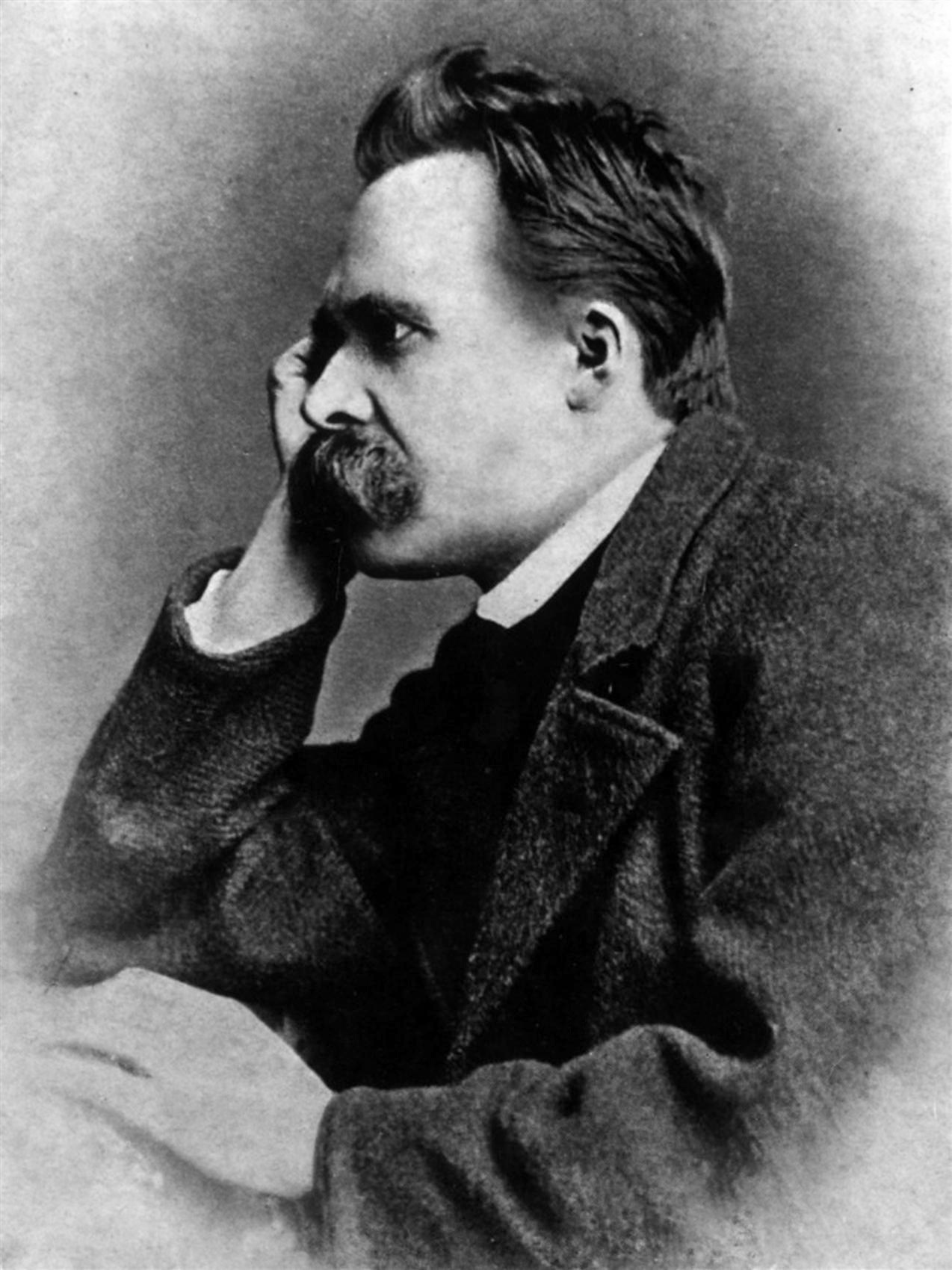
Nietzsche did not just disagree with the philosophical tradition. He thought the philosophical tradition had been asking the wrong questions.
Friedrich Nietzsche (1844–1900) was born in Saxony, the son of a Lutheran pastor who died when Nietzsche was four. He was raised in a household of women, educated at a prestigious boarding school, and showed such intellectual promise that he was appointed Professor of Classical Philology at the University of Basel at age twenty-four, before he had even completed his doctoral dissertation. It was an almost unheard-of appointment, and it set him up for a career that would, over the following two decades, steadily demolish everything he had been hired to represent.
His first book, The Birth of Tragedy (1872), was a scandal. Written under the influence of Wagner and Schopenhauer, it argued that Greek tragedy expressed a collision between two fundamental drives, the Apollonian (reason, order, beautiful form) and the Dionysian (ecstasy, dissolution, primal creativity), and that modern culture had suppressed the Dionysian to its own impoverishment. Classical scholars were appalled by the book's methods and conclusions. Students stopped enrolling in Nietzsche's courses. His academic career never recovered.
Through the 1870s and early 1880s he broke successively with Wagner (whom he came to see as a cultural fraud), with Schopenhauer's pessimism, and with the entire tradition of German idealist philosophy. Each break was documented in a series of increasingly brilliant and increasingly isolated books: Human, All Too Human (1878), Daybreak (1881), The Gay Science (1882, which contains the famous parable of the madman announcing the death of God). By 1879 chronic ill health had forced him to resign from Basel with a small pension. For the next decade he lived a nomadic life, moving between boarding houses in Switzerland, northern Italy, and the French Riviera, writing at a furious pace while his eyesight deteriorated and his headaches became debilitating.
His most productive decade, the 1880s, produced the works for which he is now best known: Thus Spoke Zarathustra (1883–85), Beyond Good and Evil (1886), On the Genealogy of Morality (1887), Twilight of the Idols and The Antichrist (both 1888). In January 1889 he collapsed in a square in Turin, embracing a horse that had been flogged. He never recovered his sanity. He spent the last eleven years of his life in a state of mental incapacitation, first in an asylum, then in the care of his mother and, after her death, his sister Elisabeth. He died in 1900.
His sister, Elisabeth Forster-Nietzsche, spent the decades after his collapse managing his literary estate and selectively editing and promoting his work in ways that aligned it with German nationalism and, eventually, with Nazi ideology. This was a profound distortion of Nietzsche's actual views: he had been sharply critical of German nationalism, contemptuous of antisemitism, and deeply hostile to the herd mentality that fascism would later exploit. The association of Nietzsche with Nazism is a product of his sister's manipulation, and serious Nietzsche scholarship has spent decades disentangling the two.
To understand what Nietzsche is doing in the Genealogy, you need to understand the intellectual situation he thought he was responding to.
In The Gay Science (1882), Nietzsche published the parable of the madman who runs into the marketplace crying "God is dead." The madman is not celebrating. He is horrified, and not because he believes in God, but because he understands what the death of God means for the culture that had organized itself around that belief. If God does not exist, then the entire edifice of Christian morality, which had provided Western civilization with its values for over a thousand years, no longer has its ultimate justification. The question becomes: what happens to morality now?
The obvious answer, and the one most of Nietzsche's contemporaries assumed, was that morality would survive just fine without its theological foundation. You could keep the content of Christian ethics, the importance of compassion, the equal worth of persons, the prohibition on cruelty, while dropping the metaphysical scaffolding. Kant had already tried something like this, grounding these values in reason rather than in God. The utilitarian tradition was trying something similar, grounding them in the facts of human happiness.
Nietzsche thought this answer was naive. His claim was that the content of Christian morality was inseparable from its origins, and that its origins were deeply problematic. You cannot simply inherit the values and discard the story that explains and justifies them, because the story is doing more than you think. The Genealogy is the fullest account of why he believed this.
There is also a more specific intellectual target. Nietzsche had been reading Paul Rée's The Origin of the Moral Sensations (1877), a book that tried to explain the emergence of moral concepts through evolutionary psychology. Rée argued, roughly, that behaviors we now call "good" were originally praised because they were useful to the community, and that over time people forgot the utilitarian origin and came to regard goodness as intrinsically valuable. Nietzsche found this account both wrong and philosophically cowardly. Wrong because it ignored the role of power, hierarchy, and domination in the actual history of moral concepts. Cowardly because it left the basic framework of Christian morality intact while pretending to have explained it. The Genealogy is, among other things, Nietzsche's sustained argument that Rée's kind of analysis is superficial, and that a genuinely historical account of morality reveals something far more disturbing.
The full title is On the Genealogy of Morality: A Polemic. "Polemic" is not an accident. Nietzsche is not writing a balanced survey of the history of ethics. He is making an argument, and the argument is adversarial.
A genealogy, in Nietzsche's sense, is a historical investigation into the conditions under which a concept or value emerged. It asks not "is this concept true or valid?" but "what kind of people, under what kind of circumstances, for what kinds of purposes, created this concept?" The genealogist is like an archaeologist who digs below the surface of a moral claim and asks: who built this, and why?
The assumption driving the inquiry is that origin is not irrelevant to value. If it turned out that our concept of "compassion is good" emerged not from insight into the nature of the good but from the need of the weak to restrain the strong, that would not automatically refute the claim that compassion is good. But it would change how we think about it. It would raise the question: are we committed to compassion because it is genuinely valuable, or because we have inherited a value system constructed by people who found compassion a useful weapon?
This is the question the Genealogy is designed to make unavoidable. Whether it actually succeeds in undermining the authority of moral concepts, or whether origin is simply irrelevant to validity, is one of the central philosophical debates the book has generated. That debate is what this unit’s reflection prompt will focus on.
This video covers Nietzsche's biography and place in the history of philosophy. Watch it before starting on the Preface.
Preface. Nietzsche explains what drove him to write this book: the question of the value of our moral values, which he says has preoccupied him since his early twenties. He describes his method as genealogical rather than psychological or philosophical in the usual sense, and he situates himself in opposition to the "English psychologists" (a label he applies to thinkers like Paul Rée who try to explain morality through evolutionary or utilitarian mechanisms). The Preface is short but essential for understanding what kind of project you are in.
First Treatise: "Good and Evil," "Good and Bad." This is the argument you came for. Nietzsche traces two historically distinct moral vocabularies. The first, which he calls "master morality," originated with aristocratic, ruling classes who defined "good" as a description of themselves: strong, noble, vital, excellent. "Bad" in this vocabulary is simply the opposite: weak, common, lowly. There is no moral condemnation in the word "bad"; it is a social and aesthetic distinction, not a moral judgment.
The second vocabulary, "slave morality," emerged from a very different source: the weak, the oppressed, those unable to overcome the strong by force. Unable to change their situation directly, they changed their valuation of it. They defined "good" as everything the strong were not: humble, meek, suffering, selfless. And they defined "evil" as precisely what the strong were. This revaluation, which Nietzsche calls the "slave revolt in morality," is the historical event he thinks explains the shape of Western moral consciousness.
Read both sections actively. Nietzsche is making a historical claim, a psychological claim, and an evaluative claim at the same time, and distinguishing which is which is part of the intellectual work of this unit.