Aquinas' Life and Context
A medieval Dominican who tried to reconcile Athens and Jerusalem
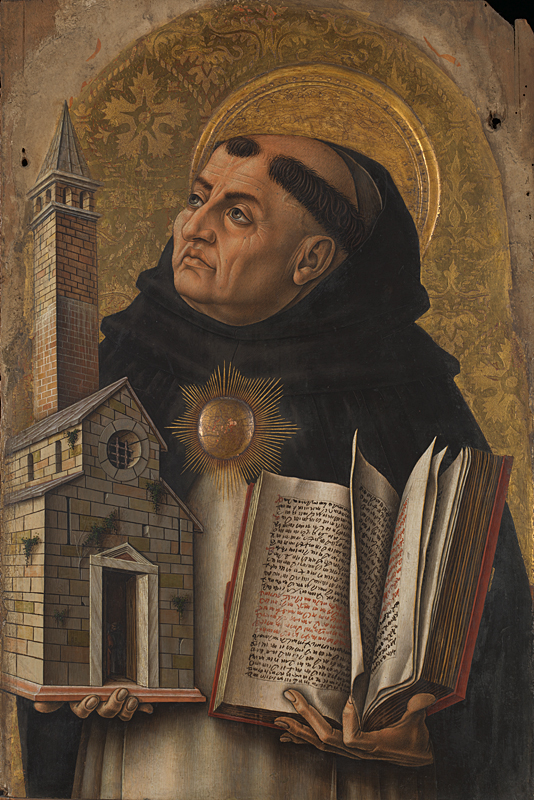
To understand what Aquinas is doing, you need to know who he was, what the Summa actually is, and why anyone in the 13th century found it revolutionary to treat Aristotle as a serious philosopher.
Thomas Aquinas was born in 1225 into a minor noble family in southern Italy. His family expected him to become a Benedictine monk, a respectable career for a younger son of the aristocracy. He disappointed them spectacularly by joining the Dominicans instead.
The Dominicans were a new order at the time, founded only a few decades earlier. They lived by begging and specialized in preaching and education. For a noble family, a Dominican vocation was roughly equivalent to a graduate from Harvard going to work as a door-to-door evangelist. Aquinas's family tried to change his mind. When that failed, his older brothers kidnapped him and locked him in a tower for over a year, hoping he would come to his senses. He did not. When they finally gave up and let him out, he rejoined the Dominicans and went to Paris to study.
At Paris, Aquinas studied under Albert the Great, one of the first medieval thinkers to take Aristotle seriously as a philosopher. This matters: Aristotle was largely lost to Western Europe for centuries, preserved and commented on by Islamic scholars (particularly Averroes) and then translated back into Latin in the 12th and 13th centuries. For educated Europeans of Aquinas's generation, the arrival of Aristotle was like the sudden discovery of a new continent of thought. It was also dangerous. Aristotle's pagan philosophy did not straightforwardly harmonize with Christian doctrine, and some Church authorities wanted to suppress him.
Aquinas spent his career building the case that Aristotle was not a threat to Christianity but a resource for it. He produced an enormous body of work: commentaries on Aristotle, commentaries on the Bible, disputed questions, and his two great syntheses, the Summa Contra Gentiles and the Summa Theologiae. He was enormous in every sense: contemporaries described him as unusually large and heavy, nicknamed "the Dumb Ox" in school (he was not dumb; he was quiet). He died in 1274, at forty-nine, on his way to a Church council.
The Summa Theologiae (the name means "Summary of Theology") is Aquinas's attempt to lay out the whole of Christian doctrine systematically, for beginners. He says so in the preface. This is worth remembering when you find the text hard: Aquinas thought he was writing an introductory textbook.
It is not an introductory textbook by modern standards. The complete work runs to several thousand pages. It is divided into three parts. The First Part covers God, creation, and human nature. The Second Part, itself divided into two sub-parts, covers ethics: the First Part of the Second Part (where our reading comes from) deals with human action, law, and virtue in general; the Second Part of the Second Part deals with specific virtues and vices. The Third Part, which Aquinas left unfinished at his death, covers Christ and the sacraments.
What you are reading is a tiny slice of the middle section, specifically the section on law. Aquinas believes that law, properly understood, is one of the main ways God directs rational creatures toward their good. The questions in our reading are his account of what law is, what kinds there are, and how they relate to each other.
The Summa has a distinctive structure that will look strange on first contact. Every individual topic is broken into a sequence of Articles, and every Article follows the same rigid template.
Each Article begins with a yes-or-no question: "Whether law is something pertaining to reason?" Then three or four objections are listed, each of which appears to argue that the answer to the question is no. Next comes a sed contra ("on the contrary"), usually a quotation from Scripture, Aristotle, or a Church Father, suggesting the answer is yes. Then Aquinas gives his own answer in a section that traditionally begins "I answer that." Finally, he goes back through the objections one by one, explaining where each one went wrong.
This is not padding. It is the Scholastic method in action. Aquinas is imagining a live disputation: a real intellectual opponent raising objections, a real argument from authority on the other side, and himself working out a position that responds to all of it. The point is to leave no serious objection unanswered.
Practically, this means you should not read every paragraph with equal weight. The heart of each Article is the "I answer that" paragraph. That is where Aquinas gives his actual position and argument. The objections and replies are important, but they are easier to follow after you know what he is defending.
My suggested reading strategy: for each Article, read the question title, the sed contra, and the "I answer that." That is the core argument. Then go back and read the objections and replies on any issue that seemed unresolved. Do not try to absorb every objection on a first pass; you will bog down in positions Aquinas himself is arguing against.
STRUCTURE OF AN ARTICLE
Question (yes-or-no): Whether X?
Objections: Arguments that X is not the case.
On the contrary: An authority suggesting X is the case.
I answer that: Aquinas's position and argument.
Replies to objections: Where each objection went wrong.
This short video gives additional background on Aquinas's life and his place in the history of philosophy. Watch it before moving on to the readings.
The four Questions we will read hang together as a unit on law, moving from the general to the specific.
Question 90 asks what law is. Aquinas works out a definition: law is an ordinance of reason, directed to the common good, made by someone with authority, and promulgated (made public). Each element matters, and each is argued for in its own Article.
Question 91 identifies the four kinds of law: eternal, natural, human, and divine. The eternal law is the plan of the divine mind itself. The natural law is our participation in the eternal law through our reason. Human law is what governments make, and it derives its authority from natural law. Divine law is what God reveals directly, through Scripture.
Question 94 zeroes in on natural law. Aquinas states its first precept, explains how further precepts follow from it, and takes up the hard questions: can natural law change, and is it the same for everyone? This is the heart of the unit.
Question 95, Articles 1 and 2 ask whether human law is useful at all, and whether an unjust human law is really a law. This is where Aquinas delivers his most famous line on law: lex iniusta non est lex, "an unjust law is no law."
Read each Question in order. The arguments build on each other, and later Questions assume the definitions from earlier ones.