Unit 5: Overview
Friedrich Nietzsche: The Genealogy of Morality
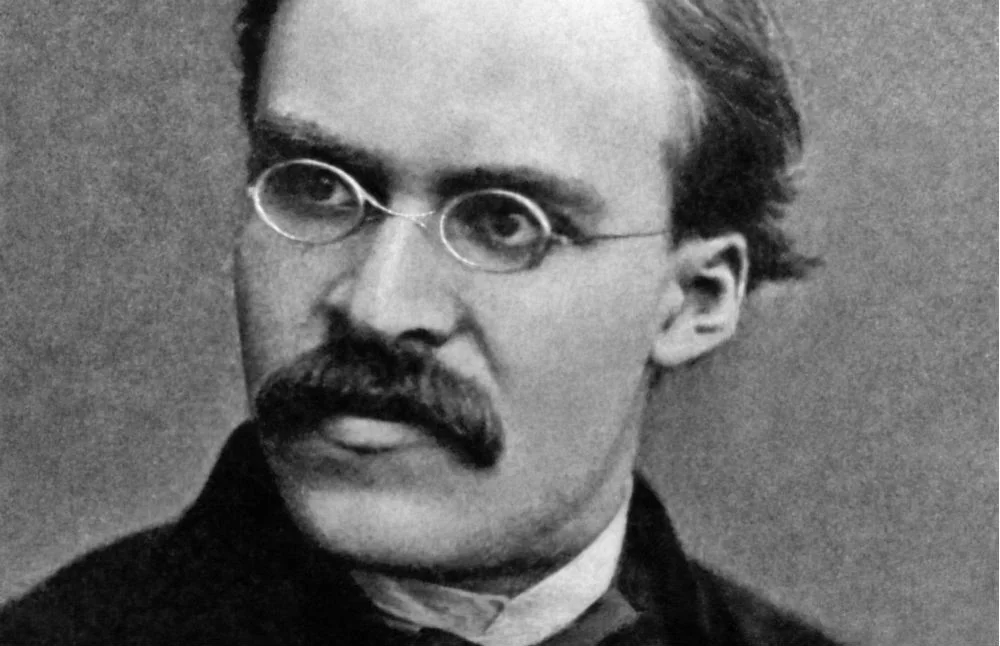
Every thinker we have studied so far has tried to give morality a foundation. Nietzsche asks whether morality deserves one.
By the time you reach Nietzsche, you have seen four serious attempts to ground morality in something stable. Aristotle grounded it in human nature and the telos of the good life. Aquinas grounded it in eternal and natural law, rooted in God's reason ordering creation. Kant grounded it in the rational structure of the will, independent of nature and history. Mill grounded it in the observable facts of human happiness and suffering. Each account is different, but each shares an assumption: that morality has a foundation, that it is not simply a historical accident or a disguised expression of something less dignified.
Nietzsche rejects the assumption. His question in the Genealogy of Morality is not "what is the correct moral theory?" but "how did our moral concepts come to be the way they are, and what does their history reveal about their worth?" When Nietzsche traces the genealogy of the concepts "good" and "evil," he claims to find something unsettling: that these concepts did not emerge from insight into moral truth, from reason, or from compassion. They emerged from resentment. The weak, unable to overcome the strong by force, overcame them by redefining strength as evil and weakness as goodness. The victory of this "slave morality" is, on Nietzsche's account, one of the most consequential events in Western history, and one of the most philosophically interesting.
You do not have to agree with Nietzsche. Some of his claims are historically dubious, many are deliberately provocative, and his writing is aphoristic and unsystematic by design. What you do have to engage with is the underlying challenge: if our moral vocabulary has a particular history rooted in particular interests and power relations, what follows? Does the origin of a moral concept have any bearing on its validity? Is Nietzsche giving us a reason to abandon morality, to revise it, or simply to understand it more honestly?
← LOOKING BACK | LOOKING AHEAD →
The four thinkers before Nietzsche disagreed about where morality comes from but agreed that it comes from somewhere stable: nature, reason, God, or the structure of human well-being. Nietzsche's genealogical method is designed to destabilize all of those answers by showing that what we call moral truth has a history, and that history is not flattering. Unit 6 will take up Simone de Beauvoir, who shares Nietzsche's rejection of fixed moral essences but tries to build a positive ethics out of that rejection rather than stopping at the critique.
Nietzsche is the most stylistically demanding writer in this course. He does not argue the way philosophers usually argue: building premises toward a conclusion, anticipating objections, seeking systematic coverage. He writes in aphorisms, extended metaphors, polemical asides, and sudden reversals. He is deliberately unsettling. Some passages are written to provoke rather than to persuade, and distinguishing provocation from argument is part of the work of reading him.
The Genealogy is more structured than much of his writing, which is one reason it works well in an introductory course. The Preface tells you what kind of inquiry you are in for. The First Treatise traces the historical emergence of "good" and "evil" as moral categories and argues that this emergence reveals something troubling about the moral tradition we have inherited. Reading both carefully will give you what you need for the lecture pages, the reflection prompt, and the quiz.
A NOTE ON THE TRANSLATION
Our reading uses Ian Johnston's translation, which is available open-access. Johnston's English is clear and reads well. Where Nietzsche's German is deliberately harsh or colloquial, Johnston preserves the edge rather than softening it into academic prose. If you encounter a passage that seems blunt or even offensive, that tone is usually intentional on Nietzsche's part.
By the end of this unit, you should be able to:
- Explain what Nietzsche means by a "genealogy" of morality and why he thinks this kind of inquiry matters.
- Describe the distinction between master morality (good/bad) and slave morality (good/evil), and explain how each originates according to Nietzsche.
- Explain the concept of ressentiment and the role it plays in the emergence of slave morality.
- Describe Nietzsche's account of the "slave revolt in morality" and the historical forces he associates with it.
- Explain Nietzsche's critique of the "English psychologists" and what he thinks they get wrong about the origin of moral concepts.
- Articulate and assess the challenge that genealogical debunking poses to the authority of moral concepts.
All of our Nietzsche reading comes from the opening sections of On the Genealogy of Morality, the book Nietzsche considered his most systematic work. Ian Johnston's translation is free to read online; the link opens its table of contents.
- Nietzsche, On the Genealogy of Morality (1887), Preface and First Treatise
- Preface: Nietzsche's account of what prompted the inquiry and what kind of inquiry it is
- First Treatise: "Good and Evil," "Good and Bad" — the genealogy of our central moral categories
ATTRIBUTION
Friedrich Nietzsche, On the Genealogy of Morality (1887), translated by Ian Johnston. Translation copyright © Ian Johnston. Made available for educational use at Vancouver Island University.
What you need to complete this unit
Work through each item in order.
- Read the lesson pages in this unit and watch the lecture videos on them
- Read the assigned text (see Readings above)
- Complete the reflection prompt
- Take the unit quiz
ACCESSIBILITY
If any material in this unit is not accessible to you, please contact me by email right away. I will work with you to find a solution.
In This Unit
- Nietzsche's Life and Context
- The Genealogical Method
- Master Morality, Slave Morality, and the Revaluation of Values
- Reflection Prompt
- Quiz: Friedrich Nietzsche