Unit 6: Overview
Simone de Beauvoir: The Ethics of Ambiguity
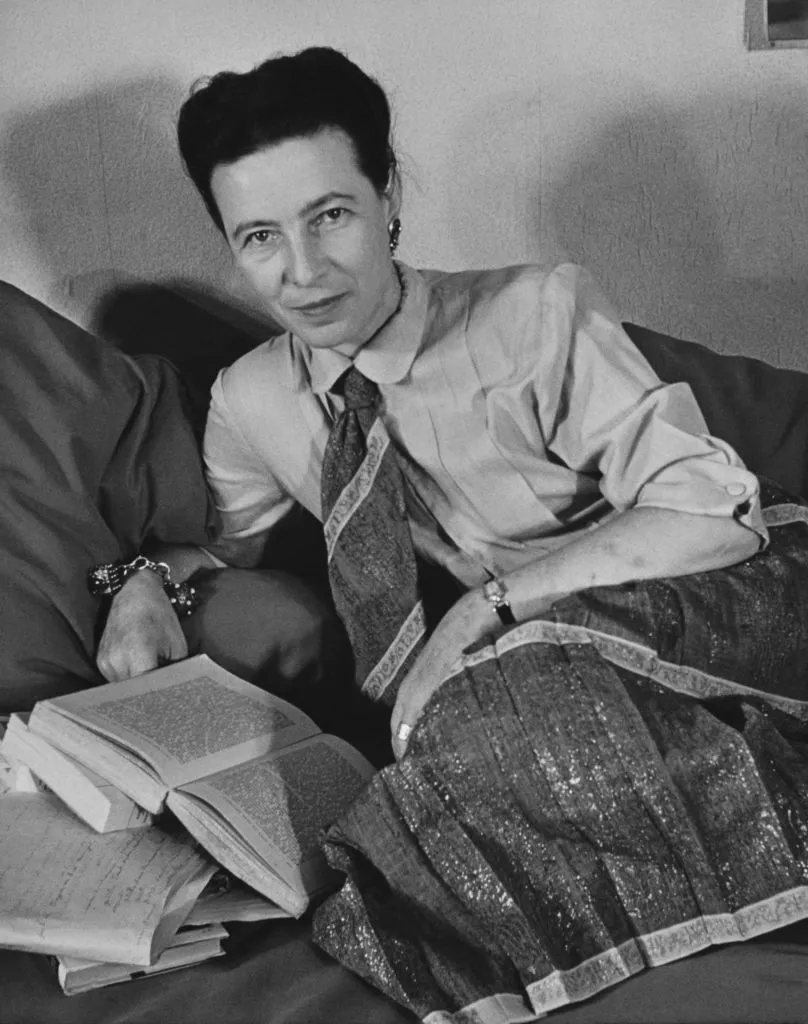
Nietzsche showed that the foundations of morality are historically contingent. De Beauvoir asks what we are supposed to do about that.
By the time you arrive at de Beauvoir, you have seen the full arc of what this course set out to trace. Aristotle located the foundation of morality in human nature and the telos of the good life. Aquinas located it in eternal and natural law, rooted in divine reason. Kant located it in the structure of rationality itself. Mill located it in the observable facts of human happiness. Nietzsche challenged all of these by showing that our moral vocabulary has a history, and that history is not flattering.
De Beauvoir begins where Nietzsche ends, but she draws a different conclusion. If there is no fixed human nature, no eternal law, no rational structure that dictates our values in advance, then we are radically free. We did not choose to be free; freedom is what we are. Every choice we make, including the choice not to choose, is an exercise of freedom. And that freedom is not a gift but a burden, because it means that the meaning of a human life is not given to us from outside but must be created by us from within.
This is existentialism, and it would seem to leave ethics behind. If there are no fixed values and no predetermined human nature, how can there be moral obligations? De Beauvoir's answer is what makes The Ethics of Ambiguity one of the most important works in twentieth-century moral philosophy. She argues that freedom, properly understood, is not compatible with indifference to others' freedom. To genuinely will one's own freedom is to will the conditions under which freedom can flourish, and those conditions are not private; they require the freedom of others. A coherent ethics is not only possible without a fixed moral foundation, she argues, but is demanded by the very structure of freedom itself.
Whether this argument succeeds is the central question of the unit. The answer will also bring the course's central thread to its close: five thinkers have located morality in nature, God, reason, happiness, or history. De Beauvoir locates it in freedom and its implications, and she does so without God, without a fixed nature, without rationalist foundations, and in the full recognition of Nietzsche's genealogical challenge. This is where the course ends up, and the ending is not a comfortable resting place.
← LOOKING BACK
Nietzsche argued that our inherited moral vocabulary is a historical product of resentment and power rather than insight. De Beauvoir takes this seriously but refuses to stop at the critique. She agrees that there is no fixed essence to appeal to. She disagrees that this makes ethics impossible. The move from Nietzsche's diagnosis to de Beauvoir's positive ethics is the intellectual bridge this unit asks you to cross.
De Beauvoir writes in a philosophical style shaped by French existentialism, which is denser and more phenomenological than the Anglo-American analytic tradition. She assumes familiarity with Sartre's framework of freedom, facticity, and bad faith, though the lecture pages will give you what you need to follow her argument without having read Sartre. Her prose is precise but not always easy; it rewards slow, careful reading more than scanning.
The two parts we are reading do different things. Part One, "Ambiguity and Freedom," sets up the philosophical problem: what does it mean to be a being who is both free and situated, both transcending its circumstances and embedded in them? Part Two, "Personal Freedom and Others," works through the ways people evade this condition and argues for what genuine, authentic freedom looks like in contrast.
A NOTE ON THE TEXT
Our reading uses the Bernard Frechtman translation, accessed through the Marxists Internet Archive. Frechtman's English is clear and has been the standard translation since 1948. De Beauvoir herself approved it.
By the end of this unit, you should be able to:
- Explain what de Beauvoir means by "ambiguity" and why she thinks it is the fundamental condition of human existence.
- Describe de Beauvoir's existentialist starting point: why radical freedom entails radical responsibility.
- Distinguish the main attitudes of bad faith in Part Two (the sub-man, the serious man, the nihilist, the adventurer, the passionate man) and explain what makes each an evasion of genuine freedom.
- Explain de Beauvoir's claim that to will one's own freedom is also to will the freedom of others, and assess the argument for it.
- Explain how de Beauvoir responds to the challenge that existentialism, by rejecting fixed values, makes ethics impossible.
- Position de Beauvoir's account in relation to the other thinkers in the course, especially Nietzsche.
All of our de Beauvoir reading comes from The Ethics of Ambiguity (1947), her major work in moral philosophy. The link opens the full text, divided into its parts.
- De Beauvoir, The Ethics of Ambiguity (1947), Parts One and Two
- Part One: Ambiguity and Freedom — the philosophical problem of human existence as both free and situated
- Part Two: Personal Freedom and Others — the typology of inauthentic attitudes and the case for genuine freedom
ATTRIBUTION
Simone de Beauvoir, The Ethics of Ambiguity (1947), translated by Bernard Frechtman (1948). Accessed via the Marxists Internet Archive.
What you need to complete this unit
Work through each item in order.
- Read the lesson pages in this unit and watch the lecture videos on them
- Read the assigned text (see Readings above)
- Complete the reflection prompt
- Take the unit quiz
ACCESSIBILITY
If any material in this unit is not accessible to you, please contact me by email right away. I will work with you to find a solution.
In This Unit
- De Beauvoir's Life and Context
- Ambiguity and Freedom
- Authentic and Inauthentic Freedom
- Reflection Prompt
- Quiz: Simone de Beauvoir