Sartre's Life and Context
Philosophy written in the ruins of two world wars, an occupation, and a collapsing European certainty about what it meant to be human.
Four sections. Open any heading to read it. The first section, on Sartre’s life and world, is open by default.
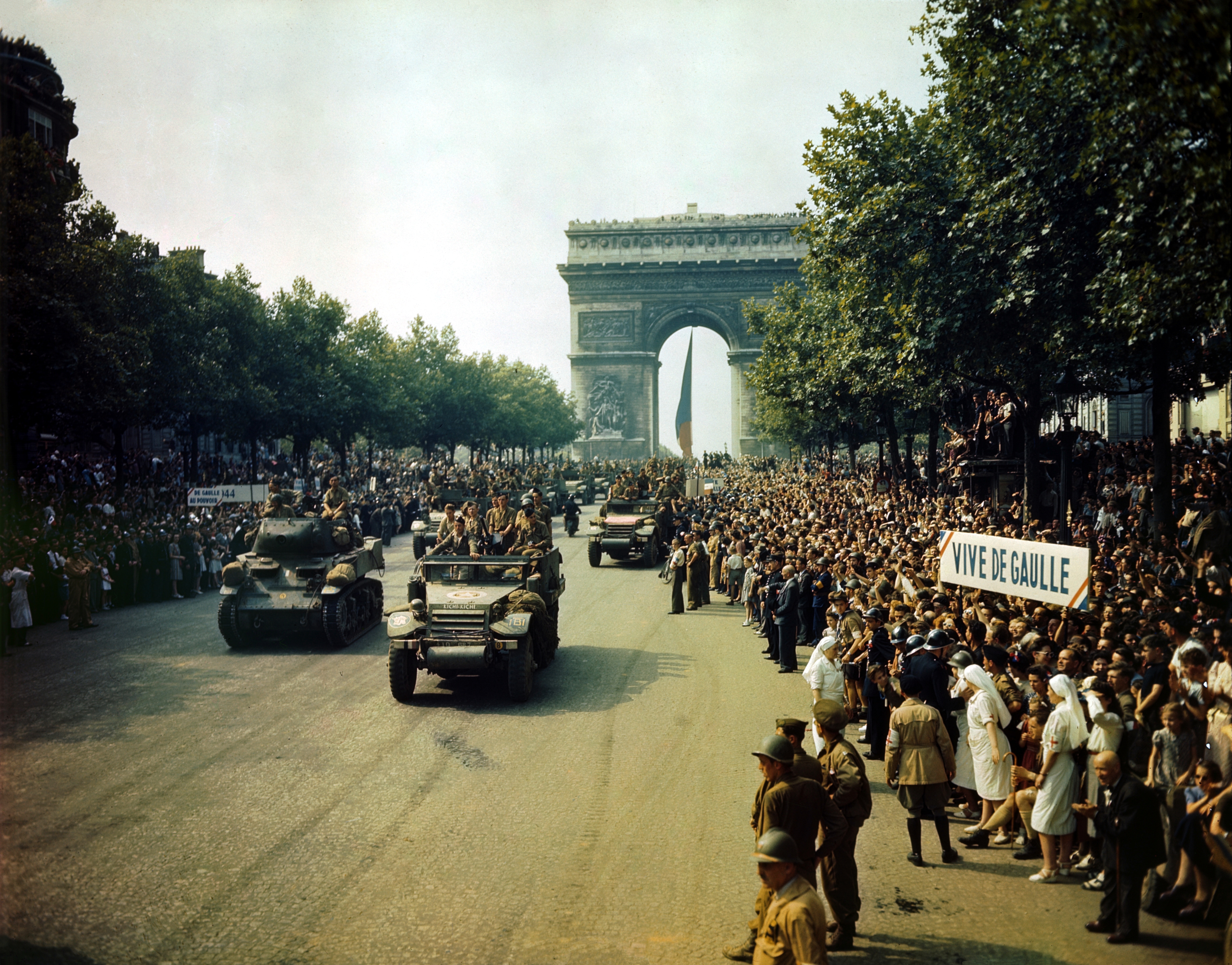
Jean-Paul Sartre was born in Paris in 1905 and died there in 1980. He lived through the two events that defined twentieth-century European intellectual life: the First World War (which he barely remembered but which formed the world he grew up in) and the Second (which he lived through, was captured in, and wrote philosophy during). When Existentialism Is a Humanism was delivered as a lecture in October 1945, the war in Europe had been over for five months. Paris had been liberated the previous summer. The photograph above was taken in the streets where Sartre spent most of his life.
This matters for reading him. He is not writing in the abstract about freedom — he is writing about freedom in a world that had just watched millions of people be systematically rounded up, deported, and murdered; a world in which collaboration, resistance, and complicity had been live options for everyone, including philosophers. The question “What should I do?” was not academic in Paris in 1945. The answers you gave — or refused to give — had recently determined whether your neighbors survived.
Sartre trained in philosophy at the École Normale Supérieure, the most prestigious intellectual institution in France, where he met Simone de Beauvoir, his lifelong partner and one of the twentieth century’s most important philosophers in her own right. He studied phenomenology in Berlin in 1933–34, reading Husserl and Heidegger, and those encounters shaped everything he wrote afterward. His philosophical masterwork, Being and Nothingness, was published in 1943 — in the middle of the occupation, while he was teaching in Paris. Existentialism Is a Humanism came two years later as a public summary and defense of that work.
In his later years, Sartre moved toward Marxism, attempted a reconciliation between existentialism and historical materialism in his Critique of Dialectical Reason (1960), refused the Nobel Prize for Literature in 1964, and became a major figure in French left politics. By the time of his death, he had become an institution — and like most institutions, was being argued with constantly. What matters for this course is his earlier work: the existentialism of Being and Nothingness as summarized in the 1945 lecture.
What Sartre inherited — and what he rejected
Every philosopher in this course faced the accumulated legacy of the ones who came before. Sartre’s starting point was Hegel and Marx — both unavoidable by the 1930s for any serious French philosopher — plus a new strand of German philosophy called phenomenology.
From Hegel, Sartre inherited the insight that consciousness is not simply a mirror of the world — it is active, it negates, it projects beyond what is immediately given. Hegel’s analysis of self-consciousness (particularly in the famous master/slave dialectic) influenced Sartre’s thinking about how the self relates to others. But Sartre rejected Hegel’s conclusion: he did not believe that history was the unfolding of rational Spirit toward freedom. That narrative struck him as wishful thinking on a grand scale.
From Marx, Sartre took seriously the claim that material conditions shape human life. But he refused the implication that humans are therefore determined by those conditions. If material conditions fix what you think and what you value — if the class you are born into shapes your consciousness in ways you cannot see or escape — then what becomes of individual responsibility? Sartre wanted to hold onto responsibility. That meant insisting on a freedom that no social structure could fully eliminate, even as he acknowledged how much those structures constrain.
From phenomenology (Husserl and Heidegger), Sartre borrowed the method: describe human experience as it is actually lived, rather than theorizing about it from outside. Husserl had developed careful techniques for analyzing consciousness. Heidegger had radicalized them by insisting that being-in-the-world, not detached reflection, was the basic structure of human existence. Sartre took both and pushed them further: consciousness, on his account, is not just “in” the world — it is nothing, a lack, a hole in being.
This strange claim — that consciousness is nothing — is the foundation of his entire philosophy. The lecture pages will unpack it.
A movement and a label
Sartre did not invent existentialism from scratch. Kierkegaard in the nineteenth century had already argued that the individual and her choices could not be absorbed into any system — not Hegel’s, not the church’s, not society’s. Nietzsche had announced the death of God and asked what followed from it. Heidegger had developed an analysis of human existence centered on finitude, authenticity, and what he called Dasein (“being-there”). Sartre inherited all of this — and drew different conclusions from it than some of his predecessors.
By 1945, “existentialism” was already a label attached to a cluster of thinkers. Sartre disliked the label — he thought it was being applied too loosely — but he eventually accepted it, partly because “existentialism” was the word the lecture that became this course’s reading was designed to defend. The text is, in that sense, a defense of a position under attack from two directions: from the political left (Marxists who thought existentialism was too individualist and too bourgeois) and from the religious right (Catholic critics who thought it was too pessimistic and too atheist).
Sartre’s response to both sets of critics is built into the structure of the lecture. Reading it, you should notice: he is always arguing on two fronts at once.
Two kinds of existentialist
Sartre distinguishes in the lecture between theistic existentialists (like the Catholic philosopher Gabriel Marcel) and atheistic existentialists (like himself). Both agree that existence precedes essence — that there is no fixed human nature determining what a person should be. They disagree about what follows from this. The theists say God grounds the possibility of authentic existence; Sartre says God is irrelevant even if he exists, because the absence of a designed human nature follows from human consciousness itself, not just from atheism.
Why Sartre is last
The sequence of this course is not arbitrary. We have moved from Socrates — who thought reason could discover universal truths about justice and the good — through Descartes (the certainty of the thinking self), Hume (skepticism about reason and the self), Hegel (the individual absorbed into a rational history), and Marx (the individual shaped by material conditions). At each step, some earlier certainty has been chipped away.
Sartre sits at the end of this arc for a reason: he faces the situation with the least to hold onto. God is gone. Human nature is gone. Rational history is gone. Material determinism — for Sartre — cannot be the whole story either, because it eliminates the freedom without which moral responsibility is impossible.
What is left is consciousness — but a consciousness that is radically different from Descartes’. Where Descartes found certainty in the cogito, Sartre finds only a perpetual lack, a nothingness that is always choosing itself and can never be simply “done.” The self, for Sartre, is not a substance. It is a project.
There is also a thread that runs across all six units you may want to hold onto as you read: the question of self-deception. Socrates’ interlocutors deceive themselves about what they know. Descartes wonders whether an evil demon is deceiving him. Hume’s analysis of causation reveals that we systematically confuse habit for necessity. Marx argues that ideology produces false beliefs that serve class interests. Sartre’s concept of bad faith is the deepest analysis of self-deception in the course: not the deception imposed from outside, but the one we perform on ourselves, in full awareness that we are doing it.
← Looking back
Marx’s account of ideology (Unit 5) raised the self-exemption problem: if all beliefs are products of material conditions, what makes Marx’s theory any different? Sartre’s account of bad faith locates self-deception not in social structure but in the structure of consciousness itself — in the way the for-itself is always tempted to pretend it is an in-itself. The Logic Reference page treats both concepts and notes the parallel.