Ideology, Alienation, and What Marx Got Right (and Wrong)
Stepping back to assess the argument
This page steps back from the Manifesto text to examine two of Marx’s most important ideas in depth — alienation and false consciousness — and then to assess the argument honestly: what holds up, and where does it run into trouble?
The Communist Manifesto is a political document, written for a specific historical moment, and it moves fast. To understand the philosophical depth beneath it, it helps to look briefly at an earlier text: the Economic and Philosophic Manuscripts of 1844, where Marx develops the concept of alienated labor in its fullest form. This concept does not appear by name in the Manifesto, but it is the philosophical foundation for much of what does.
The idea begins from a simple observation about what labor is, or should be. Marx holds that labor — the activity of transforming the natural world to meet human needs — is the most distinctively human activity. It is how human beings express themselves, develop their capacities, and create the world they inhabit. In its ideal form, labor is an expression of human freedom: we shape the world according to our intentions, and in doing so, we realize ourselves.
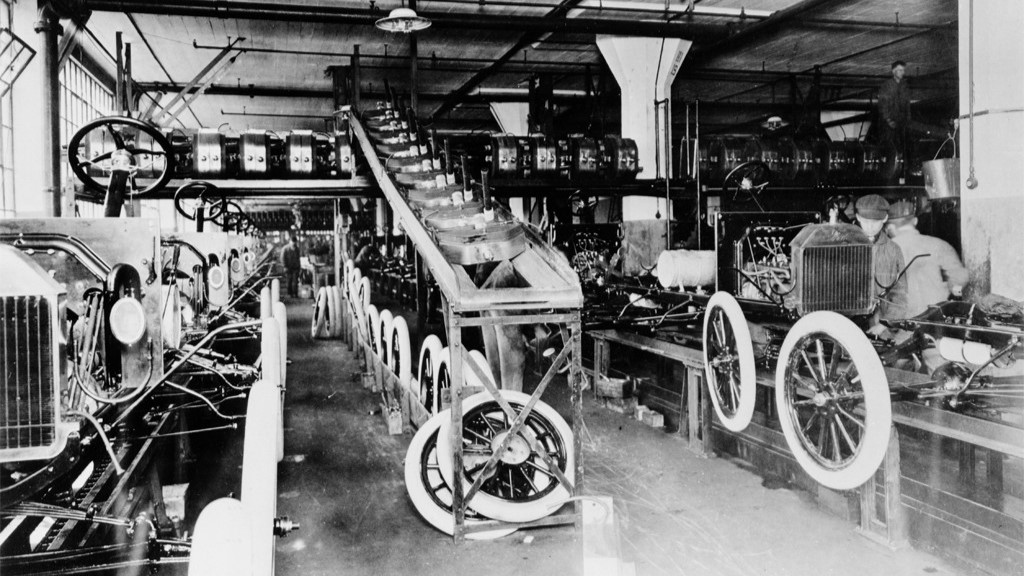
Under capitalism, Marx argues, this is exactly reversed. The worker does not own the product of their labor — it belongs to the employer. They do not control the process of production — it is organized entirely around the employer’s need for profit. They do not choose how or what they produce — they follow instructions. And the more they produce, the more wealth accumulates in the hands of those who own the factory — while the worker’s own situation remains unchanged or worsens.
The result is that labor becomes alien to the worker — something external, coerced, that belongs to someone else. The worker does not feel fulfilled in their work but exhausted by it. They feel most themselves not when they are working but when they are not working — in the hours outside the factory. Their labor, which should be an expression of their humanity, has become a means of mere survival, something endured rather than enjoyed.
This is not simply a complaint about bad jobs or unsympathetic managers. It is a structural claim: the form of alienation Marx describes is inherent to wage labor under capitalism, regardless of how pleasant or unpleasant any particular workplace might be. As long as workers must sell their labor as a commodity to those who own the means of production, they are engaged in a fundamentally alienated activity.
If the dominant ideas in any society reflect the interests of the dominant class, then many people — especially members of the working class — hold beliefs about their situation, their interests, and the justice of the social order that are systematically distorted by that very order. This is what Marxist theory calls false consciousness: a form of self-deception that is not the result of individual dishonesty or stupidity, but of social structure.
The concept is philosophically interesting because it is distinct from ordinary self-deception. When an individual deceives themselves about something — a failing relationship, a bad decision — the deception is particular and personal. False consciousness is structural: it describes an entire class of people holding beliefs that serve the interests of another class, while experiencing those beliefs as their own freely formed conclusions about the world.
Some examples of how this might work in practice. A worker who believes their low wages reflect their own lack of effort or talent, when they are actually determined by labor market conditions and the bargaining power of employers. A middle-class person who opposes policies that would benefit people in their economic position, because they have internalized an ideology that frames such policies as threats to freedom or individual responsibility. A person who regards the current distribution of wealth as broadly fair, not because they have examined the evidence but because the cultural environment they grew up in has always presented it as such.
In none of these cases is the person deliberately deceived by someone else. They are not lying to themselves. They sincerely hold these beliefs. That is precisely the point: ideology operates most effectively when it is invisible, when it produces sincere conviction rather than cynical acceptance.
▲ Logic concept — False consciousness
False consciousness is a structural form of self-deception in which a person’s beliefs about their own interests are systematically shaped by the conditions that exploit them, without their recognizing this. Unlike a simple mistake or an individual case of wishful thinking, false consciousness describes a social phenomenon: an entire group holding beliefs that serve another group’s interests while experiencing those beliefs as their own.
This raises a philosophically uncomfortable question: if our beliefs can be shaped by social conditions without our knowing it, how do we know which of our beliefs are affected? The concept does not come with an easy method for identifying when you are in its grip. That is both its explanatory power and one of the main objections to it.
See the Logic Reference page for the full entry on false consciousness.
The concept of false consciousness is one of the most powerful and most contested ideas in Marx’s legacy. It explains a great deal about why social change is difficult even when the existing order seems obviously unjust to outside observers. But it also raises serious philosophical problems, which the next section addresses.
Marx was writing about a world in rapid transformation, and he got a remarkable number of things right — or at least substantially right — about how capitalism works and what it tends to produce.
The globalization of capitalism. In 1848, Marx and Engels predicted that capitalism would expand across national borders, draw every part of the world into its network of production and exchange, and in doing so transform traditional ways of life everywhere. This description of globalization — over 150 years before the word became common — is one of the most prescient passages in the Manifesto.
The concentration of capital. Marx predicted that capitalist competition would tend to concentrate wealth in fewer and fewer hands, as smaller producers were driven out of business and absorbed by larger ones. The rise of monopoly capitalism and the degree of wealth concentration visible in contemporary economies are difficult to deny.
The instability of capitalism. Marx argued that capitalism is inherently prone to crises — periodic boom-and-bust cycles driven by overproduction, speculation, and the contradictions of the system. The history of capitalism since the Manifesto — including the Depression of the 1930s, the 2008 financial crisis, and numerous others — is at least consistent with this diagnosis.
The power of economic structures to shape culture and politics. The idea that economic interests influence political institutions and cultural values — that those with money shape the rules — is today a fairly mainstream observation. Marx was among the first to make it systematically and to explain the mechanism by which it operates.
Alienated labor as a real phenomenon. The experience of work as meaningless, disconnected from any human purpose, something to be endured for the paycheck rather than engaged with as a form of human expression — this is recognizable enough in contemporary working life that it needs little argument.
An honest engagement with Marx requires taking his failures as seriously as his insights. There are several.
The predicted revolution did not happen where or how Marx expected. Marx thought communist revolution would first occur in the most industrially advanced societies, where capitalism was most developed and the proletariat most numerous. It happened instead in Russia and China — predominantly agrarian societies with small industrial working classes. This was not a minor detail; it suggests something was wrong with the theory of how revolutionary consciousness develops.
The working class did not develop the class consciousness Marx predicted. Instead of becoming more revolutionary as capitalism matured, the working class in advanced economies became more integrated into it: through rising wages, consumer culture, union agreements, welfare states, and democratic participation. Whether this represents false consciousness on a massive scale, or a genuine improvement in working-class material conditions that invalidates the revolutionary prognosis, is contested — but it is a real challenge to Marx’s theory.
The self-exemption problem. If all ideas are shaped by class interests, then Marx’s own analysis is presumably shaped by his class position. How does he escape the trap he sets for everyone else? This is not a cheap rhetorical gotcha; it is a genuine philosophical problem about the possibility of objective social criticism from within a system that shapes all thought. Marx needs a theory of how some people can achieve critical distance from their class ideology, and his account of this is underdeveloped.
The record of actually existing communism. The political regimes that invoked Marx’s name in the twentieth century — the Soviet Union, Maoist China, and others — produced results that were, at the very least, not what the Manifesto promised. Whether this is a failure of Marxist theory, a failure of implementation, or a consequence of specific historical conditions is a question that serious scholars still debate. But it is a question that cannot be set aside.
A note on evaluating historical theories
The failures of Marxist predictions do not automatically refute every aspect of Marx’s analysis. A theory can be wrong about its predictions while being substantially right about its diagnosis. The question to ask is not simply “did it work out as predicted?” but “which specific claims were wrong, and what does that tell us about the underlying theory?” This is the kind of precise philosophical work that distinguishes careful evaluation from simple dismissal — or simple acceptance.
Two threads that have run through this entire course arrive at a particularly sharp moment with Marx.
The first is the question of the foundation of morality. The course-wide question has been: does morality have an independent foundation, or does it depend on something external? Socrates challenged divine command theory; Hume argued that moral judgments are rooted in sentiment, not reason; Hegel located moral life within the rational institutions of the state. Marx’s answer is the most destabilizing of all: moral values are not independently grounded. They are ideological. What a society takes to be just or unjust reflects the material interests of the class that controls the means of ideological production. There is no view from nowhere — no position outside of class interests from which to evaluate justice impartially.
This raises an obvious problem: if justice is ideological, on what grounds does Marx condemn capitalism as unjust? He sometimes seems to be making a moral critique — the exploitation of workers is wrong, human beings are degraded by alienated labor — while simultaneously denying that moral critique has any independent standing. This tension in Marx’s work has generated enormous philosophical commentary.
The second thread is the question of the is/ought distinction introduced in Unit 3. Hume argued that you cannot derive an “ought” from an “is” — that no description of how things are can by itself tell you how they should be. Marx often seems to be doing exactly this: arguing that because capitalism contains certain contradictions that will inevitably produce revolution, revolution is therefore what should happen. But that move is logically suspect. History moving in a certain direction does not make that direction right.
These are not knockdown objections to Marx. They are genuinely difficult problems that serious Marxist philosophers have worked on for over a century. But they are the right problems to be pressing on as you complete this unit and prepare for your reflection.
← Looking back | Looking ahead →
Hume showed in Unit 3 that we cannot get an “ought” from an “is.” Marx’s historical determinism creates an ongoing tension with this principle: he describes where history is going, but the description alone does not tell us whether we should want to get there. And his account of ideology makes moral critique from within a system extraordinarily difficult to perform without self-contradiction.
In Unit 6, Sartre will refuse both Hegel’s rational history and Marx’s material determinism. If there is no Spirit unfolding in time and no inevitable logic of class conflict, then human beings are radically free — and radically responsible. Freedom, for Sartre, is not something we achieve by overthrowing the right social structure. It is something we cannot escape, no matter what structure we live in.