Socrates' Life and Context
Who were Socrates and Plato, and why does it matter?
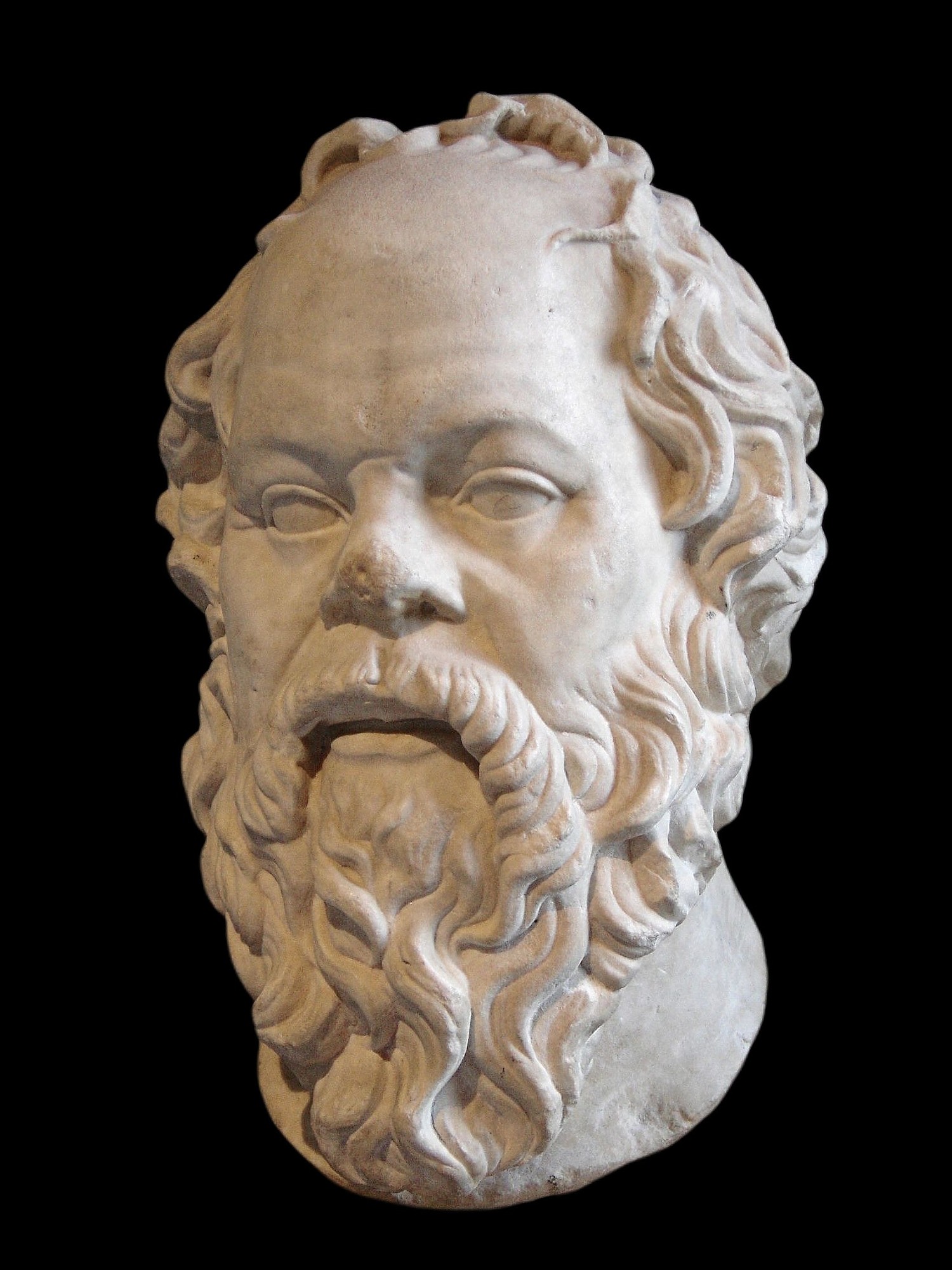
Read this page before beginning the dialogues. The historical context will help you follow what is at stake in each reading.
Socrates lived in Athens from 469 to 399 BCE, during one of the most turbulent and intellectually extraordinary periods in Western history. Athens had recently led the Greek city-states to victory over the Persian Empire, and in the aftermath it became the dominant political and cultural force in the Greek world. The Parthenon was built during Socrates' lifetime. So was Athenian democracy — and so, eventually, was its collapse.
By the time Socrates was put on trial in 399 BCE, Athens had just lost a disastrous war with Sparta, suffered a brutal oligarchic coup, and was in the process of rebuilding a democracy that many citizens blamed for the city's decline. Into this politically charged atmosphere stepped a man whose entire life’s work consisted of publicly questioning the beliefs of Athens’ most prominent citizens and finding them wanting.
The charges against him — impiety and corrupting the youth — make more sense in this context. Socrates was not simply an irritating philosopher. He was, to many Athenians, a destabilizing force at a moment when the city could least afford destabilization.
Keep in mind while reading
The three dialogues in this unit — the Euthyphro, the Apology, and the Crito — are set in the days immediately before and after Socrates’ trial and execution. They are not abstract philosophical exercises. They are a man’s response to imminent death.
Socrates was born in 469 BCE to a stonemason and a midwife. He grew up in Athens, received a standard Athenian education in poetry, music, and athletics, and served in the military. By mid-life he had become a fixture of the Athenian agora — the public marketplace — where he spent his days in conversation with anyone willing to engage him. He charged no fees, founded no school, and wrote nothing.
Everything we know about Socrates comes from others — primarily Plato, but also Xenophon and the comic playwright Aristophanes, who mocked him in the Clouds. The challenge for readers of Plato’s dialogues is that we cannot always be certain where Socrates ends and Plato begins.
The Oracle and the mission
Socrates claimed that his philosophical mission began with a pronouncement from the Oracle at Delphi, who reportedly declared that no one in Athens was wiser than Socrates. Astounded, Socrates set out to disprove the Oracle by finding someone wiser than himself — a politician, a poet, a craftsman. Each time, he discovered that the person’s reputation for wisdom far exceeded their actual understanding. They believed they knew things they did not know.
Socrates concluded that the Oracle was right, but not because he possessed special knowledge. He was wisest because he alone knew that he did not know. This — intellectual humility in the face of hard questions — is what he called Socratic ignorance, and it became the engine of his entire method.
The examined life
In the Apology, Socrates makes one of the most famous claims in the history of philosophy: that the unexamined life is not worth living. This is not an invitation to navel-gazing. It is a claim about what it means to be a rational agent. To live without subjecting your beliefs to examination — without asking whether what you take for granted is actually true — is to sleepwalk through existence.
This commitment to examination is not without cost. Socrates was convicted of impiety and corrupting the youth of Athens and sentenced to death. He was 70 years old. He refused to escape when given the chance, refused to propose a lesser penalty that might have satisfied his accusers, and drank the hemlock himself. His death was, in its own way, the final act of the examined life.
A note on sources
The biographical details above are drawn from the Internet Encyclopedia of Philosophy (IEP), a peer-reviewed open-access philosophy reference. For a fuller account of Socrates’ life, see the IEP entry on Socrates.
Plato was born around 428 BCE into one of Athens’ most prominent aristocratic families. He became a student of Socrates as a young man, and Socrates’ trial and execution in 399 BCE shaped the rest of his intellectual life. The question of how a just man could be condemned by a democratic city — and what that implies about democracy, justice, and the relationship between the individual and the state — runs through nearly everything Plato wrote.
Plato went on to found the Academy in Athens around 387 BCE, one of the earliest institutions of higher learning in the Western world. He wrote extensively, and unlike Socrates, his work survives. He died around 348 BCE.
The dialogues and their problem
Plato wrote in the form of philosophical dialogues — scripted conversations, usually with Socrates as the main character. The early dialogues, which include the Euthyphro, Apology, and Crito, are generally considered the most historically reliable portraits of Socrates. The later dialogues, including the Republic, present increasingly systematic philosophical positions that are generally attributed to Plato himself rather than Socrates.
This creates a persistent interpretive challenge: in any given dialogue, you are reading Plato’s dramatization of Socrates’ thought. You cannot assume the historical Socrates held exactly the positions his character expresses. What you can assume is that Plato found them worth putting into Socrates’ mouth — which is itself philosophically significant.
The Theory of Forms
Plato’s most distinctive philosophical contribution is the Theory of Forms — the idea that the physical world we perceive through our senses is not the most real world. Behind or above it lies a realm of eternal, unchanging, perfect Forms (sometimes translated as Ideas): the Form of Justice, the Form of Beauty, the Form of the Good. The things we see and experience are imperfect copies or instances of these Forms.
This theory has deep roots in the Socratic dialogues. When Socrates asks Euthyphro “what is piety?” he is not asking for examples of pious acts. He is asking for the Form of piety — the single thing that all pious acts have in common, the standard by which we recognize piety when we see it. The search for definitions in the early dialogues is, in embryo, the search for Forms.
Looking ahead
The Theory of Forms, Plato’s epistemology, and his political philosophy are developed further in the Republic, which appears later in this unit. The early dialogues lay the groundwork; the Republic builds the structure.
The three dialogues in this unit are set across a span of a few days. Read in sequence, they tell a single story — not just about Socrates’ death, but about the relationship between philosophy, justice, and civic obligation.
The Euthyphro
Set on the steps of the court where Socrates is about to be arraigned. Socrates meets Euthyphro, a religious expert who is prosecuting his own father for impiety. The conversation turns to the question: what is piety? Euthyphro offers several definitions; Socrates dismantles each one. The dialogue ends without a resolution — but it contains one of the most important arguments in the history of philosophy of religion.
The Apology
Socrates’ speech at his own trial. He defends his life’s work, explains the Oracle story, and argues that the unexamined life is not worth living. He is convicted and sentenced to death. The Apology is one of the clearest articulations in all of philosophy of what it means to live by one’s convictions regardless of consequence.
The Crito
Set in Socrates’ prison cell. His friend Crito arrives before dawn with an escape plan. Socrates refuses to go. The dialogue asks: do we have an obligation to obey laws we believe are unjust? Socrates’ answer — carefully argued, not merely asserted — is one of the foundational texts of political philosophy.
A note on the reading
These dialogues are short by philosophical standards — but they are not easy. Socrates’ arguments are compressed, his moves are sometimes subtle, and the dramatic framing can distract from the logical structure. When you encounter a step in an argument that doesn’t immediately make sense, slow down and ask: what is the premise here, and what is he trying to conclude? The Logic Reference page in Unit 1 can help if you need to revisit argument structure before you begin.