Marx's Life and Context
Karl Marx — from Trier to London, and from Hegel to revolution
This page covers Marx’s life and intellectual formation. Understanding how he arrived at his ideas — especially his relationship to Hegel — is essential context for reading the Manifesto.
Karl Marx was born in 1818 in Trier, a small city in the Rhineland region of what was then Prussia. His family was middle-class and educated — his father was a lawyer, and his household was steeped in the values of the European Enlightenment: reason, individual rights, liberal reform. Marx was a brilliant and restless student who moved from law to philosophy without much internal conflict about the change; he was always more interested in ideas than in legal practice.
He completed a doctorate in philosophy in 1841, writing on ancient Greek materialism — a topic that, in retrospect, signals where his thinking would eventually land. But academic life was closed to him. His political views made a university appointment impossible, and he turned instead to journalism, editing radical papers in Cologne and Paris. It was in Paris that he met Friedrich Engels, the collaboration that would define his intellectual life. Engels was the son of a factory owner, had seen industrial capitalism from the inside, and brought a practical grounding to Marx’s philosophical ambitions. The partnership was one of the most consequential in the history of ideas.
Marx was expelled from Paris in 1845, from Brussels in 1848, and eventually settled in London, where he lived in poverty for most of the rest of his life. His family depended heavily on financial support from Engels. He worked in the reading room of the British Museum, producing the dense economic analysis that would become Das Kapital. He died in 1883, two years after his wife Jenny, having outlived three of his seven children. The Communist Manifesto, written in a rush of weeks in 1847–48, was commissioned by the Communist League as a statement of principles; it is by far the most widely read thing he ever wrote.
To understand Marx, you need to understand his relationship to Hegel — which was simultaneously one of deep debt and radical disagreement.
Marx was a student when Hegel died in 1831, and Hegel’s philosophy dominated German intellectual life in the decades that followed. As a young man, Marx was drawn into the orbit of the Young Hegelians — a group of radical thinkers who took Hegel’s dialectical method seriously but pushed it in directions Hegel himself had not gone. Where Hegel had used the dialectic to justify the Prussian state as a realization of Reason in history, the Young Hegelians used it to criticize religion, politics, and the existing social order. The dialectic, they argued, did not stop at any given arrangement of things; contradiction was always still at work.
The figure who mattered most to Marx’s break from Hegel was Ludwig Feuerbach, who argued that Hegel had the whole thing upside down. Hegel had claimed that Spirit — a kind of collective cosmic consciousness — was the driving force of history, and that material reality was its expression. Feuerbach inverted this: ideas, including religious and philosophical ideas, are expressions of material human life, not the other way around. God is not the origin of human beings; God is a projection of human needs and aspirations onto an imaginary supernatural screen. This “materialist inversion” was enormously important to Marx.
Marx absorbed Feuerbach’s inversion but thought it didn’t go far enough. Feuerbach had shown that religion was a human product — but he had not asked why human beings produce it, what conditions make it necessary, what social function it serves. For Marx, this meant the analysis had to be economic and historical, not just philosophical. Ideas — including religious ideas, political ideas, and philosophical ideas — are not free-floating products of human consciousness. They arise from specific material conditions: from how people work, what they produce, and how production is organized.
This is the core of what Marx called historical materialism: the claim that the material conditions of economic life are the foundation on which everything else — law, politics, culture, philosophy, religion — is built. The next lecture page works through this idea and its consequences in detail.
The famous image
Marx described his relationship to Hegel using the image of finding Hegel “standing on his head” and setting him back on his feet. Hegel had derived the real from the ideal — from Spirit, from Reason, from Consciousness. Marx’s move was to start from the real: from human beings producing the material necessities of life, and to show how ideas, institutions, and values follow from that foundation.
The Communist Manifesto was written in 1847–48, and it is important to have some sense of what that moment looked like. Europe was in the middle of the Industrial Revolution, and the transformation was staggering in its speed and its human cost. In cities like Manchester, London, and Paris, former agricultural laborers had flooded into factory work. They worked twelve-to-sixteen-hour days, in conditions that were frequently dangerous and often deadly. Child labor was common. There were no unions, no workplace safety regulations, no minimum wages, no social safety net. The wealth being generated was enormous, and almost none of it was reaching the people doing the work.
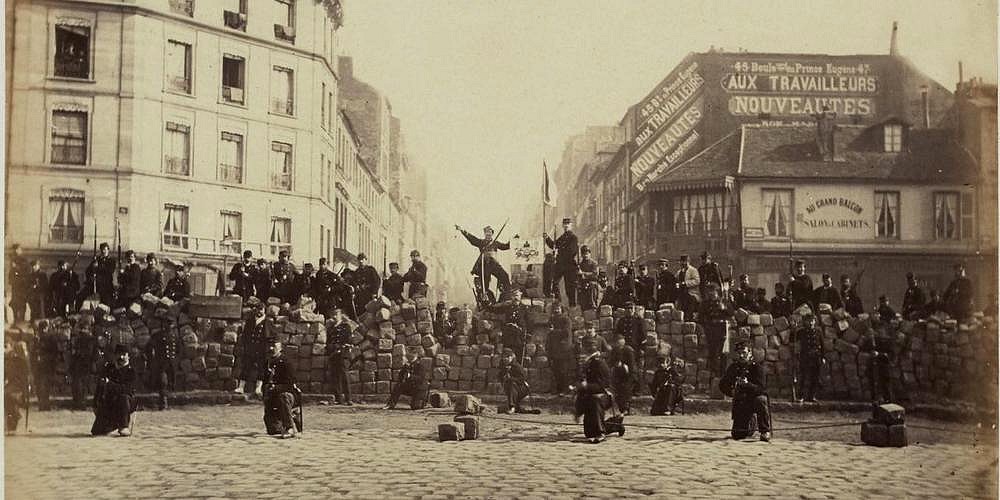
1848 was also a year of revolution. Beginning in France and spreading across Europe, a wave of uprisings shook existing governments — demands for political representation, constitutional reform, and in some cases more radical economic change. The Manifesto was published just as this wave was breaking. Most of the revolutions failed within a year. But the conditions that had produced them — industrial capitalism, mass urban poverty, enormous concentrations of wealth alongside widespread deprivation — did not go away.
This context is not just historical background. It is what Marx is analyzing. When he writes about the bourgeoisie and the proletariat, he is not constructing abstract sociological categories — he is describing a real social structure that he and his contemporaries were living inside. The philosophical question he is asking is: what explains this structure, what sustains it, and what would it take to change it?
Marx was a prolific writer across multiple genres: journalism, political pamphlets, economic analysis, philosophical manuscripts, and historical commentary. The body of work is large and uneven — some of it was not published in his lifetime, and some was incomplete at his death.
The texts that matter most for this course, beyond the Manifesto itself:
The Manifesto is the most accessible entry point, which is why it is assigned here. But be aware that it is a political document written for a specific moment, not a systematic philosophical treatise. The 1844 Manuscripts and the opening chapters of Das Kapital give a richer philosophical account of the ideas the Manifesto deploys at speed.
It is worth pausing on the exact nature of Marx’s inheritance from Hegel, because it shapes everything that follows.
Marx kept three things from Hegel. First, the dialectical method: the idea that development happens through contradiction and conflict, not through gradual smooth progress. For Marx, the contradiction is not between abstract philosophical positions but between material classes with incompatible interests. Second, the historical perspective: things are not eternally fixed; every social arrangement is the product of a specific historical moment and contains the seeds of its own transformation. Third, the conviction that philosophy cannot merely interpret the world — it must contribute to changing it. This last point is the famous eleventh thesis on Feuerbach.
What Marx discarded was Hegel’s idealism: the claim that Spirit, Consciousness, or Reason is the driver of history. For Marx, this gets causation backwards. Consciousness does not determine life; life determines consciousness. People’s ideas about the world — their religious beliefs, their political values, their sense of what is just and natural — are shaped by the material conditions of their existence, and particularly by their position within economic relationships of production.
This is not just a philosophical point. It has direct consequences for how we think about ideas — including the ideas in our own heads. If Marx is right, we cannot simply trust our intuitions about justice, freedom, or the natural order of things. Those intuitions may be expressions of the system we inhabit rather than independent assessments of it. The next lecture page examines exactly this claim.
← Looking back | Looking ahead →
Hegel argued in Unit 4 that the rational is real: that Reason is not a tool we bring to the world but something at work in the world itself, unfolding through history. The existing order was not just what happened to exist — it was Reason realizing itself in time. Marx found this politically intolerable. It seemed to him that Hegel’s philosophy, for all its radical method, had ended up justifying the status quo.
In Unit 6, Sartre will push the question further: if material conditions shape consciousness, and if history is driven by impersonal economic forces, what becomes of individual freedom and responsibility? Sartre’s answer — that we are condemned to be free regardless of our circumstances — is in direct tension with Marx’s structural account of human life.