Unit 1: Overview
The last days of a philosopher — and the questions he left behind
This page is organized into five sections. Click any heading to open it — you can have multiple sections open at once.
What this unit is about
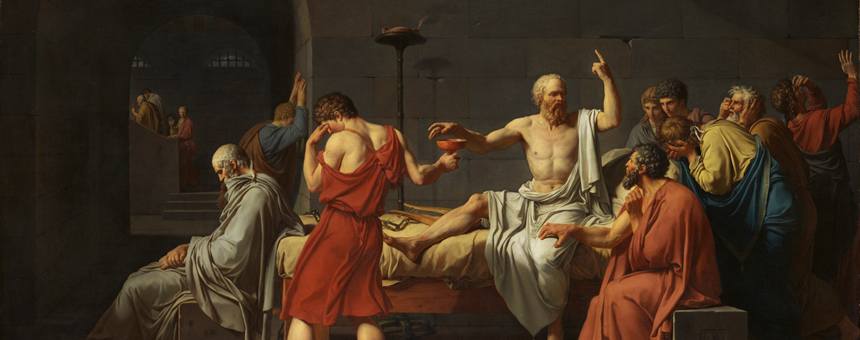
In 399 BCE, a 70-year-old Athenian man named Socrates was put on trial, convicted, and executed. His crimes, according to the city of Athens, were corrupting the youth and failing to honor the city’s gods. His response, according to his student Plato, was to argue that the unexamined life is not worth living — and to refuse every opportunity to escape or soften his sentence.
This unit follows Socrates through three short dialogues, each capturing a different moment in his final weeks. Together they form a single story about what philosophy is, why it matters, and what it might cost you.
The three dialogues, in order
The Euthyphro takes place outside the law court, just before Socrates goes inside to hear the charges against him. He runs into a man named Euthyphro, who is about to prosecute his own father for murder — because, Euthyphro insists, it is the pious thing to do. Socrates asks him what piety actually is. The dialogue that follows raises one of the oldest questions in ethics: is something right because a divine authority commands it, or is it commanded because it is already right?
The Apology is Socrates’ defense speech at his trial. (The Greek word apologia means “defense,” not “apology” in the modern sense.) Rather than playing to the jury, Socrates argues that he is Athens’ greatest benefactor — a gadfly sent to sting the city awake. He is convicted and sentenced to death.
The Crito takes place in prison. Socrates’ old friend Crito arrives with money and a plan to help him escape. Socrates refuses. He argues that escaping would be unjust — a betrayal of the agreement any citizen makes by choosing to live under a city’s laws. The dialogue forces a question that political philosophy has wrestled with ever since: when, if ever, is it right to disobey the law?
Why it matters
These three dialogues are the foundation of Western philosophy not because Socrates had all the answers, but because he had a method for exposing the questions we hadn’t thought to ask. You’ll encounter that method throughout this course — not just in Plato, but in every philosopher who came after him.
Looking ahead → Unit 2
The central question of the Euthyphro — does morality depend on divine authority, or does it have an independent foundation? — will reappear in a new form when we reach Descartes. Descartes will argue that God is the guarantor of reason itself. But if that’s true, could God have made two plus two equal five? Keep Euthyphro’s dilemma in mind.
Before you read: watch this first
This short video introduces the central philosophical problem of the Euthyphro — the divine command theory and the dilemma Socrates poses — before you encounter it in the text. Watch it now, commit to your own position, and then see how Socrates handles the same question.
Crash Course Philosophy #33: “Divine Command Theory” (~10 min). Captions available via YouTube.
Before you continue
The video ends without resolving the dilemma — that’s intentional. Before moving on, take a moment to write down which position you find more compelling, and why. You’ll be asked to revisit this in your reflection.
What to notice in the video
— The two “horns” of the dilemma: what does each one commit you to?
— Why Socrates thinks neither horn is satisfactory
— What the dilemma assumes about the relationship between God and morality
Unit readings
All three dialogues are short — together they amount to fewer pages than a typical novel chapter. Read them in order; each one sets up the next. The links below go to the MIT Classics translations, which are free and openly accessible.
Primary texts
- Plato, Euthyphro — full dialogue
- Plato, Apology — full dialogue
- Plato, Crito — full dialogue
A note on reading Plato
Plato writes in dialogue form — meaning you are reading a scripted conversation, not an essay or a textbook. Socrates almost never states his own view directly. Instead, he asks questions. Your job as a reader is to follow the argument step by step and notice where it succeeds or breaks down.
It helps to read with a pencil. Mark any moment where you think: “Wait — does that actually follow?” Those are exactly the moments worth noting when you write your reflection.
Reading tip
The Euthyphro ends without a definition of piety. Euthyphro walks away. This is not a flaw in the dialogue — it is the point. Ask yourself: what has been accomplished, if anything?
Handouts for this unit
These PDFs accompany the readings. Download them before you begin. The first is especially important if you have not read philosophy before.
Accessibility
If you use a screen reader or require an alternative format for any of these documents, please contact your instructor. All course materials can be made available in an accessible format upon request.
What you need to complete this unit
Work through each item in order.
- Watch the introductory video
- Read the lesson pages in this unit
- Read the assigned text and review the handouts
- Complete the reflection prompt
- Take the unit quiz
In This Unit
- Socrates' Life and Context
- The Euthyphro
- The Apology
- The Crito
- Reflection Prompt
- Quiz: Socrates and Plato