Descartes' Life and Context
Who was Descartes, and why did certainty become the urgent question?
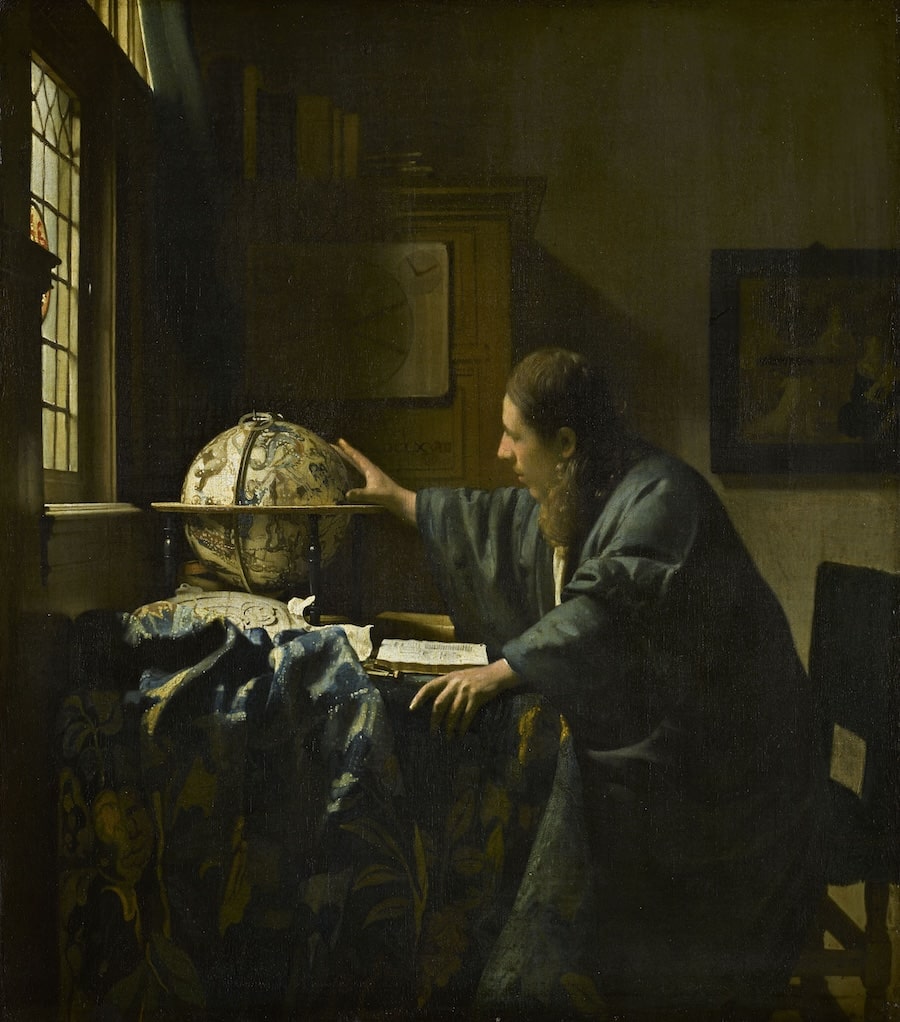
Read this page before beginning the Meditations. The historical and intellectual context will help you understand why Descartes was asking the questions he was — and why they felt urgent.
René Descartes was born in 1596, into a Europe that was tearing itself apart and rebuilding itself at the same time. The continent had been fractured by the Protestant Reformation, which had shattered the religious unity of Western Christendom and produced decades of devastating warfare. The Thirty Years’ War — which killed roughly a third of the population of Central Europe — was being fought during the years Descartes was writing the Meditations. Authority that had once seemed unquestionable was being questioned everywhere.
At the same time, a revolution in natural knowledge was underway. Copernicus had argued that the Earth moves around the Sun, not the other way around — a claim that directly contradicted both common sense and Church teaching. Galileo had confirmed and extended Copernicus’s work using the telescope, and in 1633, just eight years before the Meditations appeared, he was forced by the Inquisition to recant. Kepler had described the elliptical orbits of the planets. The old Aristotelian picture of the world — which had served as the foundation of both science and theology for over a millennium — was crumbling.
Descartes absorbed all of this. He was a mathematician and scientist as well as a philosopher — he invented the Cartesian coordinate system that still bears his name, and made significant contributions to optics. But the deeper question the Scientific Revolution raised was not just what the world is like. It was: how do we know? If the authorities we had trusted for centuries were wrong about the cosmos, what could we actually rely on? What method could produce knowledge that was genuinely secure?
Keep in mind while reading
The Meditations is not an exercise in abstract skepticism for its own sake. Descartes is trying to find a method that could put human knowledge on a foundation as solid as mathematics — secure enough to survive the collapse of every authority that had previously underwritten it.
René Descartes was born in La Haye en Touraine, France, in 1596. His mother died when he was a year old, and he was raised largely by his grandmother. He was educated at the Jesuit college of La Flèche — one of the finest schools in Europe at the time — where he received a thorough grounding in scholastic philosophy, mathematics, and the natural sciences. It was there, he later wrote, that he came to feel that for every question he was taught to answer, a dozen better questions had been left unasked.
After graduating, Descartes enrolled in the army — not out of patriotism, he claimed, but because military life gave him the freedom to think. He spent years traveling through Europe, observing the world and, by his own account, learning more from experience than from books. In 1619, he had a series of vivid dreams that he interpreted as a divine calling to found a new science based on mathematical reason. He spent the rest of his life pursuing that ambition.
Descartes eventually settled in the Netherlands, which offered greater intellectual freedom than France. He published works on mathematics, optics, meteorology, and cosmology, but suppressed his main scientific treatise — called Le Monde — when he heard of Galileo’s condemnation in 1633. He was a Catholic, and he had no wish to collide with the Church. Instead, he published the Discourse on the Method in 1637, with three scientific essays attached as illustrations of his method. The Meditations on First Philosophy appeared in 1641, with a set of objections from leading scholars — including Thomas Hobbes and Pierre Gassendi — and Descartes’ replies appended.
In 1649, Queen Christina of Sweden invited him to Stockholm to serve as her personal philosophy tutor. The invitation was flattering but the conditions were brutal: the Queen insisted on conducting her lessons at five in the morning. Descartes, who had made a lifelong habit of lying in bed until late morning to think, developed pneumonia in the Swedish winter. He died in February 1650, at the age of fifty-three.
A note on religion
Descartes was a sincere Catholic, and the Meditations is explicitly dedicated to the theology faculty at the Sorbonne. His proofs of God’s existence are not rhetorical gestures — he genuinely believed they were philosophically sound. Whether they are is one of the central questions of the unit. But they should be read as serious arguments, not as attempts to placate the Church.
Descartes’ central philosophical project is sometimes called foundationalism: the idea that knowledge needs to be built from the ground up, on a foundation that is absolutely certain. He uses the image of a building whose foundations have cracked. You cannot repair it by patching individual walls. You have to tear it down and start again from solid ground.
The method he uses is radical doubt — sometimes called hyperbolic doubt because it goes far beyond ordinary skepticism. Descartes does not ask: might this belief be mistaken? He asks: is it conceivably possible that this belief is false? Any belief that passes that test — any belief that could, even in principle, be wrong — gets set aside. Only what survives absolute doubt can serve as a foundation.
This is an unusual strategy. Most people, if they want to figure out what they know, start by looking at the world. Descartes starts by turning away from the world entirely and looking inward — at the thinking mind itself. This shift is sometimes called the Cartesian turn, and it is one of the most consequential moves in the history of philosophy. After Descartes, the question how do we know? takes priority over the question what is there?
Logic concept: foundationalism
Foundationalism is the view that all knowledge rests on a set of basic beliefs that do not themselves require justification from other beliefs — they are self-evident, or certain in some direct way. The Meditations is a sustained attempt to find those foundational beliefs and show how everything else can be derived from them. As you read, notice how each conclusion becomes the premise for the next argument. The whole structure is deductive, in the same way a geometric proof is. See the Logic Reference page for more on deductive arguments.
Two questions to carry into the reading
— Is hyperbolic doubt a legitimate philosophical tool, or is it a trick? Does it actually matter whether a conceivably deceiving demon exists?
— If Descartes needs God to guarantee reason, but uses reason to prove God exists, is there a problem? This puzzle — called the Cartesian Circle — will come up in the lecture pages. Notice it when you first encounter it.
Each meditation has a specific job to do in the overall argument. Here is what to look for in each one.
Meditation I — The Method of Doubt
Descartes builds three doubt-inducing arguments in sequence, each stronger than the last: unreliable senses, the possibility of dreaming, and the Evil Demon hypothesis. Watch how far doubt goes by the end. What, if anything, survives?
Meditation II — The Cogito
Cogito ergo sum: I think, therefore I am. This is the foundation. Notice how Descartes gets here, and then notice what he does next: the wax argument, which argues that the mind is better known than the body. The mind/body distinction begins here.
Meditation III — The Existence of God (causal argument)
Descartes argues from the idea of God in his mind to the conclusion that God must exist as its cause. This is dense and slow. Take your time. The concept of degrees of reality — covered in one of the handouts — is essential here.
Meditations IV & V — Error, Will, and a Second Proof of God
Meditation IV explains how error is possible in a world created by a non-deceiving God: we misuse our will. Meditation V offers the ontological argument — God’s existence follows from the very concept of God, the way mathematical truths follow from their definitions. Both meditations complete the scaffolding before Meditation VI.
Meditation VI — Mind, Body, and the External World
With God’s guarantee in place, Descartes argues that the material world exists, and that the mind and body are really distinct substances. The problem this immediately raises — how does an immaterial mind move a physical body? — is one Descartes never fully solved, and one philosophers are still arguing about.
Looking ahead → Unit 3
Descartes trusts reason to deliver certain knowledge — once properly deployed, and with God as guarantor. David Hume will argue, less than a century later, that reason is far weaker than Descartes believed. For Hume, even the most basic assumptions about cause and effect turn out to rest not on reason at all, but on habit.