The Crito
Civil disobedience, the social contract, and the limits of obligation
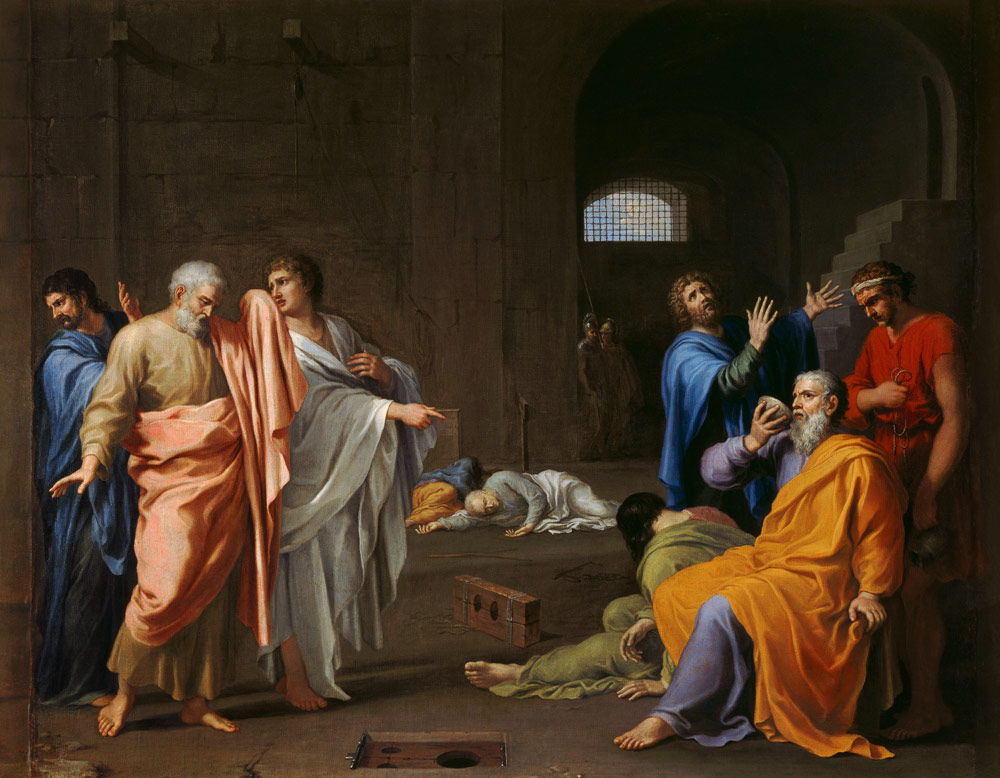
Read this page alongside or after the Crito. It unpacks Crito’s arguments, Socrates’ responses, and the argument from agreement that lies at the heart of the dialogue.
The Crito takes place in Socrates’ prison cell, a few days before his execution. His old friend Crito arrives before dawn with an escape plan. Friends have arranged everything: guards have been bribed, money is available, a comfortable life in exile awaits. All Socrates has to do is leave.
Socrates refuses. The dialogue that follows is his explanation of why. It is one of the most important texts in the history of political philosophy: a careful argument for the obligation to obey the law, even when one believes the law has been unjust in its application to oneself.
The question the Crito raises — are we bound to obey laws we believe are unjust? — is not merely academic. It is the question behind every act of civil disobedience: Thoreau refusing to pay the poll tax, Rosa Parks refusing to give up her seat, conscientious objectors refusing military service. Socrates’ answer is complicated, and it has been contested ever since.
Crito offers several arguments for why Socrates should escape. They range from the practical to the moral, and they deserve careful attention — because Socrates does not dismiss them as obviously wrong. He takes them seriously before rejecting them.
The practical arguments
Crito argues that Socrates’ death will harm his friends: people will assume they were too cowardly or too cheap to arrange an escape. He adds that money is not a problem — funds have been arranged. And a good life in exile is possible.
Socrates’ response: the opinion of the many does not matter. Only the opinion of those who understand justice is worth attending to. This is not arrogance — it is a consistent application of the principle that one should be guided by reason and expertise, not by reputation or popular sentiment.
The moral arguments
Crito’s stronger arguments are moral. First: by staying, Socrates is cooperating with his enemies in wronging him. He would be acting unjustly against himself by accepting an unjust verdict. Second: he has children and an obligation to raise them. Dying unnecessarily abandons them.
These are not trivial arguments. The obligation to one’s children is a genuine moral consideration, and the idea that accepting an unjust punishment is itself unjust is philosophically interesting. Socrates does not simply wave them aside — he argues that they are outweighed by the argument from agreement.
Logic in action: valid vs. sound
Notice that Socrates never says Crito’s arguments are invalid — that the conclusions don’t follow from the premises. They do follow. What Socrates challenges are the premises: specifically, the premise that public opinion matters when it comes to justice, and the premise that an obligation to one’s children can override an obligation to one’s city. Crito’s arguments are valid but, Socrates contends, not sound. For the distinction, see the Logic Reference page in Unit 1.
Socrates’ central argument is presented through a personification: he imagines the Laws of Athens speaking to him. The Laws make the following case for why Socrates must stay.
Socrates has lived his entire life in Athens. He was born here, educated here, raised a family here. He could have left at any time — after the trial, or earlier — but he chose to remain. In choosing to remain and benefit from the city’s laws (its courts, its protection, its civic institutions), he implicitly agreed to abide by them. This is a form of social contract: not a signed document, but a tacit agreement that comes with accepting the benefits of living under a legal system.
The Laws compare Socrates’ relationship to the city with a child’s relationship to a parent: you are not permitted to do injustice to your parents even if they have done injustice to you. The asymmetry matters. Individual citizens benefit from laws they did not themselves create, and they carry an obligation toward the institution that makes those benefits possible, even when it fails them in a particular instance.
The argument from agreement, reconstructed
This argument is valid: if all premises are true, the conclusion must follow. The interesting philosophical questions concern the premises — especially P2 (can silence constitute consent?) and P4 (is it never right to break a just agreement when the other party wrongs you?). Reconstructing the argument this way makes those questions visible.
Logic in action: reconstructing arguments
The argument box above shows what it means to reconstruct an argument: to extract its premises and conclusion from the prose in which they are embedded, and make the logical structure explicit. This is one of the most valuable skills in philosophy. Once an argument is reconstructed, you can evaluate each premise independently — which is much harder to do when the argument is buried in narrative. Try doing this with one of Crito’s arguments as a practice exercise.
Socrates’ conclusion — that we are bound to obey the law even when it wrongs us — has been deeply influential and deeply contested. The philosopher Martin Luther King Jr. drew on Socratic and natural law traditions when arguing for civil disobedience, but reached a very different conclusion: that there is a moral obligation to disobey unjust laws, not merely a permission.
Several objections to Socrates’ argument deserve serious consideration:
These are not fatal objections — Socrates’ defenders have responses to each. But they show that the Crito’s conclusion is not a settled matter. It is an invitation to further inquiry, which is, after all, the Socratic point.
The thread across the course
The question of political obligation — what we owe to our communities, and what our communities owe us — runs through Units 4, 5, and 6. Hegel sees the state as the highest expression of ethical life; Marx sees it as an instrument of class domination; Sartre insists on radical individual freedom. Socrates’ argument from agreement is where this conversation begins.
These questions are to guide your reading. You do not submit answers — but you should be able to answer them before working on your reflection.