The Manifesto: Argument and Program
What the communists want, why they want it, and how they respond to their critics
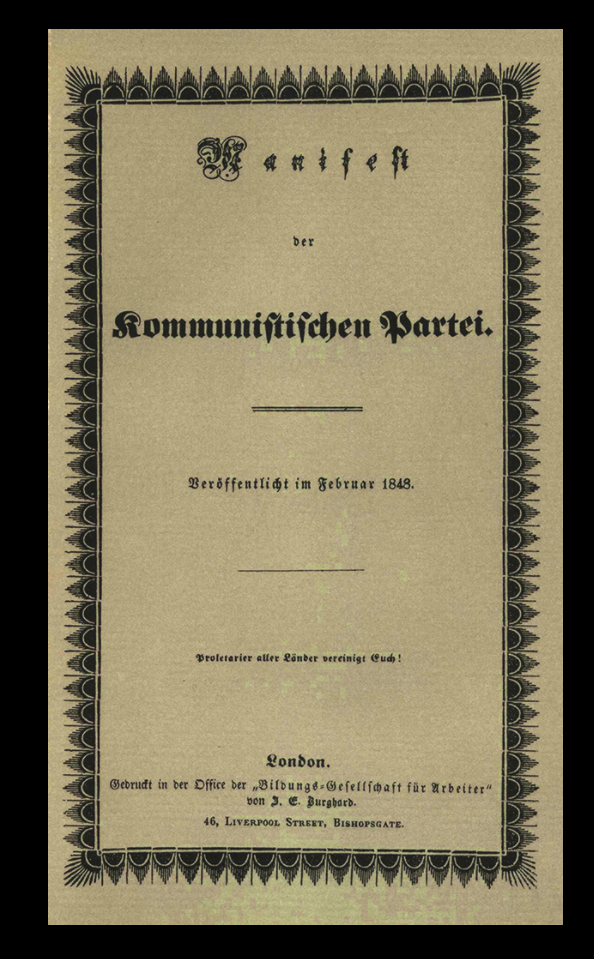
This page works through Parts 2, 3, and 4 of the Manifesto: the communist program, the case for abolishing private property, Marx’s critique of rival socialist positions, and the closing call to action.
Part 2 of the Manifesto opens with a question that Marx and Engels use to structure everything that follows: what is the relationship of the communists to the working class as a whole, and what do they propose?
Their answer to the first part is that communists are not a separate party with interests different from those of the proletariat. They represent the interests of the working class as a whole, across national boundaries, and with a clearer theoretical understanding of where those interests lead than most workers yet have. They do not promise some separate vision of the good society; they articulate what the logic of the workers’ own situation points toward.
The answer to the second part is more confrontational: the immediate aim is the formation of the proletariat into a class, the overthrow of bourgeois supremacy, and the conquest of political power by the working class. The long-term aim is a society without classes and without the state as an instrument of class domination. Marx and Engels are explicit that this will require radical transformation, not gradual reform within the existing system.
The ten-point program at the end of Part 2 is often quoted and frequently misrepresented. It is worth reading it carefully in its own context: it is a list of measures for the transitional period, not a description of the final communist society. Some of the measures — progressive income tax, free public education, centralization of the means of communication and transport — would be unremarkable in most contemporary democracies. Others, like the abolition of inheritance and the nationalization of land, are more radical. The list is also explicitly offered as applicable to the most advanced countries; Marx was already aware that different conditions would require different applications.
The most misunderstood claim in the Manifesto is probably the call to abolish private property. People routinely take this to mean that Marx wants to confiscate everyone’s belongings — their clothes, their furniture, their savings account. He explicitly addresses this misreading and calls it a confusion.
The distinction Marx draws is between personal property and capital. Personal property is the property of ordinary life: the things you use, consume, and live with. Capital is a fundamentally different kind of property: the means of production — factories, machinery, land — used to employ the labor of others and extract profit from that labor. It is not merely a large amount of property; it is property that grows by commanding the labor of those who have none.
Marx’s argument is that what he is proposing to abolish is not property in general but the specific form of property that defines class exploitation: the ownership of the means of production by a class that does not do the work, who profit by employing those who do. The worker’s wages, personal savings, and household goods are not what he has in mind.
A question to hold onto
The distinction between personal property and capital makes sense in theory. But is it always clear where one ends and the other begins? A small business owner employs a few workers and profits from their labor — is that capital in Marx’s sense? What about a person who rents out a room in their home? The edges of the category are worth pressing as you read.
Marx also takes on the charge that abolishing private property would destroy the incentive to work. His response is that under capitalism, the great majority of people have no capital — and yet they work, because they must. Work is not primarily motivated by the prospect of capital accumulation; it is a human activity that has been distorted and alienated by capitalism. A society organized around common ownership of the means of production would not eliminate labor; it would transform its character.
Part 3 is the most historically dated section of the Manifesto, and also the one students most often skip or skim. That would be a mistake. Marx and Engels are doing something philosophically important here: they are distinguishing their position from other critiques of capitalism that they regard as either superficial or actively counterproductive. Understanding their objections illuminates what is specific about their own view.
They identify three broad types of socialism and explain why each is inadequate:
Reactionary socialism comes in several varieties, but they share a common structure: they criticize capitalism from the perspective of a social order that capitalism has displaced. Feudal aristocrats who resent the bourgeoisie for destroying the old hierarchies; petty-bourgeois shopkeepers and craftspeople who feel squeezed out by industrial capitalism; German intellectuals who dressed up their conservative politics in socialist language. The problem with reactionary socialism is not that its critique of capitalism is entirely wrong — it sometimes identifies real harms — but that it looks backward. It wants to return to a social order that was itself built on exploitation.
Conservative or bourgeois socialism accepts capitalism but wants to soften its edges: philanthropists, social reformers, economists who want free trade with lower tariffs, or better working conditions without challenging the ownership structure. Marx is withering about this position. It wants the advantages of capitalism for the bourgeoisie without the social consequences. It treats the symptoms without touching the cause.
Critical-utopian socialism is the most interesting of the three and the one Marx treats with the most respect, even as he rejects it. The utopian socialists — thinkers like Saint-Simon, Fourier, and Owen — produced brilliant critiques of capitalist society and imaginative visions of how things could be organized differently. Their problem, Marx argues, is that they appealed to reason and justice as universal principles, and hoped that enlightened individuals — including members of the ruling class — would recognize the truth of their vision and reform society accordingly. This approach mistakes the nature of the problem: if class interests shape what counts as reasonable and just, appeals to reason and justice cannot get above those interests. Social transformation requires the organized political action of the proletariat, not the persuasion of those who benefit from the existing order.
This critique of utopian socialism is directly connected to the analysis of ideology from the previous lecture page. And it raises a question worth sitting with: if Marx is right that the ruling ideas are always the ideas of the ruling class, how does anyone — including Marx himself — get outside that framework to see things clearly?
Part 4 is short — barely a page — and it is the most explicitly political section of the text. Marx and Engels lay out the relationship of the communists to other opposition parties: they support every revolutionary movement against the existing social and political order, wherever they can. They do not yet form a single, unified international organization, but they support all working-class movements and all democratic causes.
The final paragraph is among the most famous in modern political writing. It ends with a call for workers across national borders to unite, on the grounds that they have nothing to lose but their chains and a world to win. It is worth reading this as a philosophical claim as well as a political one: Marx is arguing that the proletariat, uniquely, has a universal interest — not a class interest that happens to conflict with another class interest, but an interest in the abolition of class itself.
This is the most audacious claim in the Manifesto, and also the most contested. Is there really a perspective from which the interests of the proletariat coincide with the interests of humanity as a whole? Or is this simply the universalization of one class’s particular interests — precisely what Marx had accused the bourgeoisie of doing?
One of the skills this course has been building from Unit 1 onward is the ability to read a philosophical text as an argument: to identify the premises, trace the reasoning, and evaluate the conclusion. The Manifesto is a good test of that skill because it is designed to be persuasive, and its rhetorical energy can make it easier to feel moved by it than to track exactly what is being claimed and why.
A useful exercise as you finish the text: try to reconstruct the main argument in its simplest form. Something like:
Now press on each premise. Which ones are most vulnerable? Which rest on empirical claims about history that could be challenged with counter-examples? Which depend on theoretical assumptions about how capitalism works? The next lecture page picks up the evaluation of this argument — both what is compelling about it and where it runs into trouble.