The Apology
The trial, Socratic wisdom, and the examined life
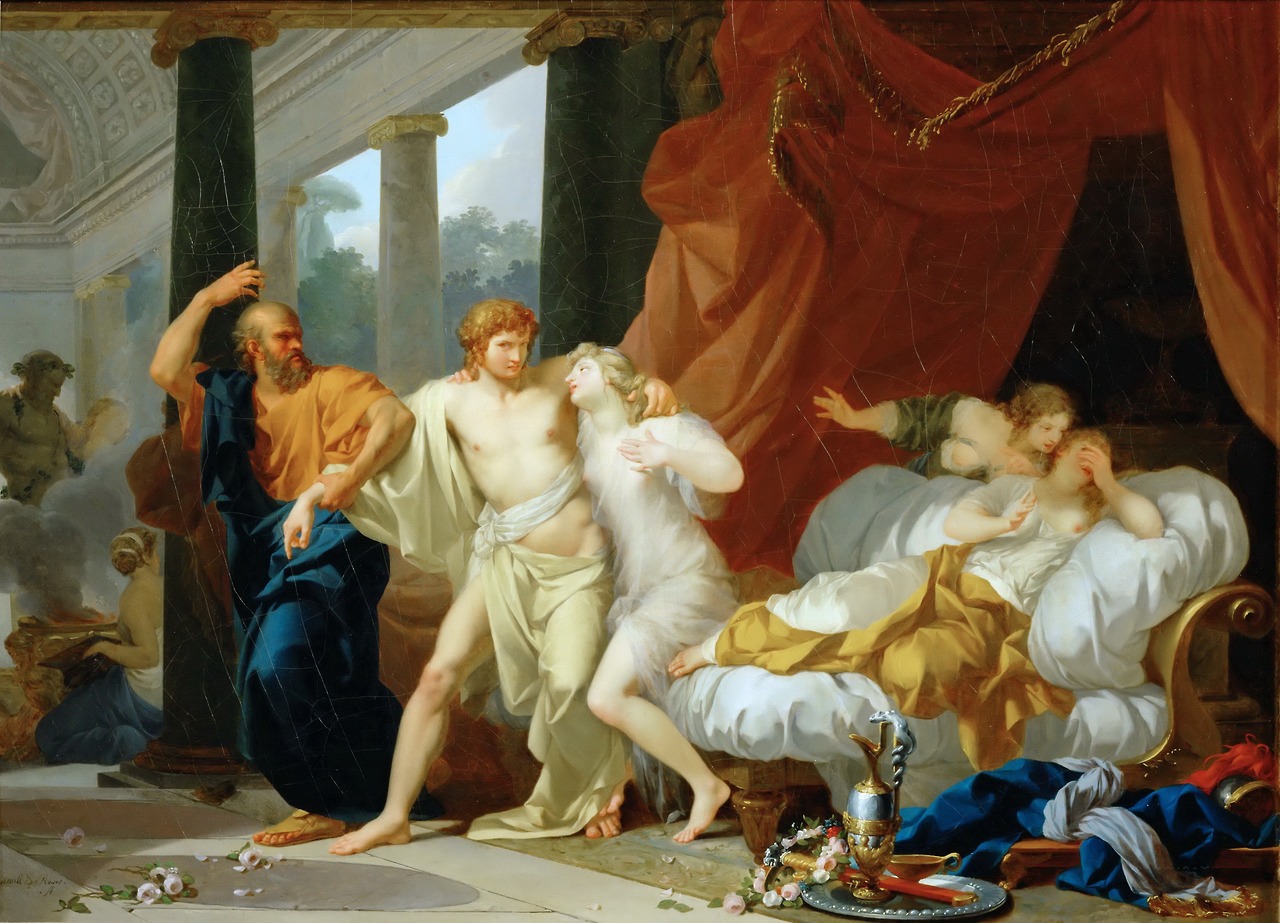
Read this page alongside or after the Apology. It unpacks the charges, the defense, and the philosophical stakes of Socrates’ trial.
In 399 BCE, Socrates was put on trial before a jury of 501 Athenian citizens on two charges: impiety (failing to acknowledge the gods the city acknowledges, and introducing new divine beings) and corrupting the youth. He was convicted by a narrow majority and sentenced to death.
The Apology — from the Greek apologia, meaning a formal defense speech, not an expression of regret — is Plato’s account of what Socrates said at his trial. Whether it is verbatim or a dramatization, we cannot know. What is clear is that it presents a coherent philosophical defense of Socrates’ life’s work, not just a legal brief.
Logic in action: ad hominem
Socrates notes early in the Apology that his accusers have built a reputation for him — that he is a sophist, a manipulator, a dangerous eccentric — long before addressing any specific argument he has made. This is a textbook ad hominem: attacking the person rather than engaging with their reasoning. Socrates responds by doing the opposite — addressing the arguments directly, not the reputation. For the full account of this fallacy, see the Logic Reference page in Unit 1.
Socrates’ defense begins with a story. His friend Chaerophon once asked the Oracle at Delphi whether anyone was wiser than Socrates. The Oracle replied: no one. Socrates was baffled — he did not think of himself as wise. So he set out to investigate by finding someone wiser than himself.
He visited politicians, poets, and craftsmen — all celebrated for their expertise. In each case he found the same pattern: they believed they knew far more than they actually did. Their confidence in their knowledge was not matched by genuine understanding. They were, in a sense, victims of their own reputations.
Socrates concluded that the Oracle was right, but in a specific sense: he was wiser than others not because he knew more, but because he knew that he did not know. This is Socratic ignorance — not a counsel of despair, but an intellectual stance: the refusal to claim certainty you do not have, combined with the willingness to keep inquiring.
The deeper point
Socratic ignorance is not modesty for its own sake. It is an epistemic position: the belief that most people’s confidence in their own knowledge is unwarranted, and that recognizing this is the beginning of genuine understanding. This connects directly to what we will encounter in Unit 2, when Descartes strips away everything he thinks he knows in search of what can be known with certainty.
Socrates’ defense is not just autobiography. It is a series of arguments, each addressing a specific charge or concern. Reading the Apology as an argument is one of the best exercises in reconstructing philosophical reasoning you will encounter in this course.
On corrupting the youth
Socrates argues that he cannot have intentionally corrupted the youth. His reasoning: if associating with him made people worse, then he would also be made worse by living in bad company — since bad people harm those around them. But harming oneself is irrational. Therefore, if he corrupted the youth, he did so unintentionally. And if unintentionally, the remedy is instruction, not punishment. The charges presuppose intentionality; without it, they collapse.
Logic in action: burden of proof
Throughout his defense, Socrates presses his accusers on burden of proof — the obligation to provide evidence for the claims you are asserting. In a trial, the prosecution carries the burden of proving the charges. Socrates repeatedly demands to know what actual evidence supports the accusation that he has corrupted anyone, or introduced false gods. The charges, he implies, rest on reputation and resentment, not argument. He is right to demand more.
On the fear of death
After his conviction, Socrates addresses the fear of death directly. He argues that to fear death is irrational unless we know that death is bad. But we do not know this. Death may be nothing at all — an eternal dreamless sleep — in which case there is nothing to fear. Or it may be a passage to a place where Socrates can continue his inquiry with the great minds of history. Either way, the fear of death, if it caused him to abandon his philosophical mission, would be worse than death itself.
This argument is not mere bravado. It is connected to a broader claim about what counts as a harm. Things are not bad simply because they feel unpleasant or because others fear them. They are bad if and only if they damage what actually matters — and for Socrates, what actually matters is the condition of one’s soul, one’s capacity for rational inquiry and just action.
The Apology’s most famous line appears when Socrates is asked to propose an alternative punishment. He refuses to propose exile or silence — the two options that might have saved his life — because either would require him to stop philosophizing. He would rather face death than abandon inquiry. Then he states the reason: the unexamined life is not worth living.
This is a strong claim and it deserves scrutiny. Socrates is not saying that only philosophers live well. He is saying that a life in which one never reflects on one’s beliefs, values, or assumptions — never asks whether what one takes for granted is actually true — is not a fully human life. The capacity for rational inquiry is not just one of many goods; it is constitutive of what it means to be a person rather than merely an organism.
The jury convicted him anyway. Socrates is, in the end, executed for doing what he believed was his duty — the duty to examine, question, and refuse to accept comfortable certainties. Philosophy is, in this sense, a dangerous activity.
A question worth sitting with
Do you agree that the unexamined life is not worth living? What would Socrates say to someone who responds: “I live a good life — I care for my family, I do my job, I’m happy. Why do I need to examine anything?” Keep this in mind when you write your reflection.
These questions are to guide your reading. You do not submit answers — but you should be able to answer them before working on your reflection.